Understanding Similarity Transformations and Dilations
Learn about similarity transformations, including translations, rotations, reflections, and dilations. Understand the concept of dilations, center of dilation, and scale factor. Practice drawing dilations and calculating scale factors.

Understanding Similarity Transformations and Dilations
E N D
Presentation Transcript
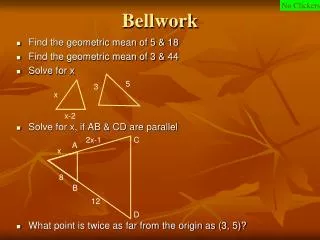
No Clickers Bellwork • Find the geometric mean of 5 & 18 • Find the geometric mean of 3 & 44 • Solve for x • Solve for x, if AB & CD are parallel • What point is twice as far from the origin as (3, 5)? 5 3 x x-2 2x-1 C A x 8 B 12 D
Bellwork Solution • Find the geometric mean of 5 & 18
Bellwork Solution • Find the geometric mean of 3 & 44
Bellwork Solution • Solve for x 5 3 x x-2
Bellwork Solution C • Solve for x, if AB & CD are parallel A x 2x-1 8 12 B D
Bellwork Solution • What point is twice as far from the origin as (3, 5)?
Perform Similiarity Transformations Section 6.7
The Concept • We’ve covered most of chapter 6, but we have yet to apply our understanding of similarity to objects on the coordinate plane. • Today we’re going to use our understanding of similarity and transformations to discuss similarity transformations.
Review • We’ve seen three kinds of transformations thus far • Translations • Shifts or moves up or down and right or left • Rotations • Object rotations a direction and angle about the origin • Reflections • Flips of an object either over the x-axis or the y-axis • The last one that we will learn about is dilations
Definitions • Dilation • Special kind of transformation that stretches or shrinks a figure to create a similar figure • Figures are either reduced or enlarged • Type of similarity transformation
Definitions • Center of Dilation • Fixed point with which the object is dilated • Scale factor of dilation • Ratio of a side length of the image to the corresponding side length of the original figure
Coordinate Notation • We prefer to be able to notate for dilations • For dilations centered at the origin • (x,y)(kx,ky), where k is a scale factor • If 0<k<1, reduction • If k>1, enlargement
Drawing a Dilation • Draw a dilation of an object with vertices (0,2), (5, 3) & (5,-3) using a scale factor of 2
Drawing a Dilation • Draw a dilation of an object with vertices (4,6), (2, 4) & (6,-6) using a scale factor of 1/2
Example Draw a dilation of a quadrilateral ABCD with vertices A(2,2), B(4,2), C(4,0), D(0,-2). Use a scale factor of 1.5 and label the object FGHJ
Scale or k factor • We’ve discussed scale factor before and defined it as • The quotient of a side length of the second object and the corresponding side length of the first object • This property of dilations is no different • For example, find the scale factor of these two objects 2 1
Example • We can also determine k factor from points • Find the k factor between these two objects What do we need in order to give an accurate answer
Example • Is the green object a dilation of the yellow one? How do we know?
Practical Example • You are using a photo quality printer to enlarge a digital picture. The picture on the computer screen is 6 centimeters by 6 centimeters. The printed image is 15 cm by 15 cm. What is the scale factor of the enlargement?
Homework • 6.7 Exercises • 1, 2-8 even, 9-23, 25, 26
Example Draw a dilation of a quadrilateral ABCD with vertices A(-3,5), B(3,4), C(4,-2), D(-3,-2). Use a scale factor of 1.5 and label the object FGHJ
Most Important Points • Definition of Dilation • Bounds for the k scalar • Performing Dilations • Finding k factor from points