Download
1 / 5
50 likes | 152 Vues
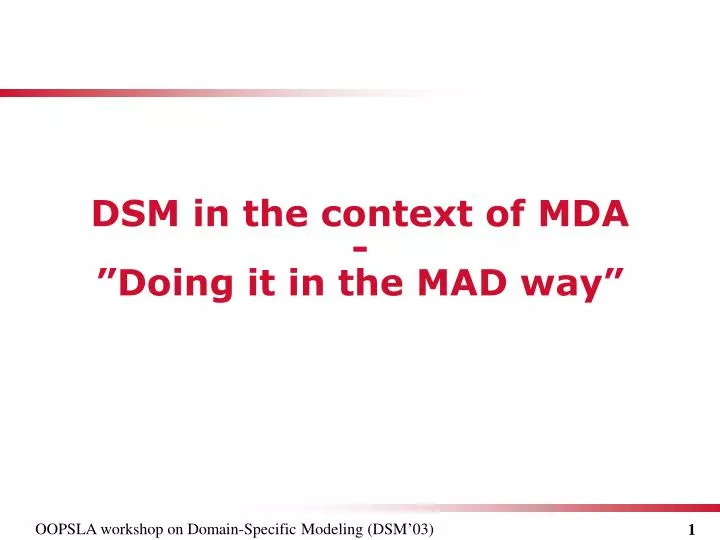
Explore the background, assumptions, and future of Domain-Specific Modeling (DSM) in the context of Model-Driven Architecture (MDA). Learn about metamodeling, transformations, aspect-orientation, and the importance of tools for DSM development. Dive into hot DSM topics and future research areas in MDA.

E N D
Background and basic assumptions • Faster, safer and easier development more and more relevant as we are more dependent on software • Ideas behind MDA have been done earlier in DSM/DSLs • these are propriety and not available to public as gives competitive advantage • Two ”schools” of OMG’s MDA • MDA based on UML • Metamodeling (like MOF) is needed The right one • Behavior very important and maybe easier to see more domain-specific than static structures? • Tools for building DSMs are needed
What has been done • Public metamodels currently made by platforms owners: they own the domain • Transformations • Model to code • Model to model less: mostly between static (class) diagrams • Transformations guided by profiles (not on markings, patterns, types?) • Lack of publicly available MDA references, expected to increase
Collect "hot topics" in DSMs • Aspect-orientation an adaptation technique for weaving DSM • Integration based on metadata becomes popular in industry • Different ways to raise abstraction (parameters, composition generation, modeling language) • QVT (Query View Transformation) for transformations
Future research topics • MOF need to be extended (not only conceptual) • Multiple transformations (not only PIM to PSM) • What happens to transformations result • Management of MDA • Versioning of 1) metamodels, 2) profiles, 3) models, 4) transformations together • organizationally • What kind of metamodeling language we should have: Bootstrap MDA • How to fit DSM & Generators to that of we are working today? • Aspect-orientation in models (part of language) • How to hook generated result (models) to code to be written manually (the needed 20%) • Tools a big research issue