Understanding the Pythagorean Theorem for Right Triangles
160 likes | 298 Vues
The Pythagorean Theorem is applicable solely to right triangles and is crucial for calculating the lengths of sides. Given a triangle where 'c' is the hypotenuse, you can find missing lengths using the formula ( a^2 + b^2 = c^2 ). For example, if ( a = 3 ) and ( b = 4 ), then ( c ) can be calculated as 5. This concept can be applied to various cases, including when provided with a hypotenuse and one leg. In practical scenarios, such as Mark's journey involving the shortest route from his home to the store, the theorem can help determine the minimal distance.


Understanding the Pythagorean Theorem for Right Triangles
E N D
Presentation Transcript
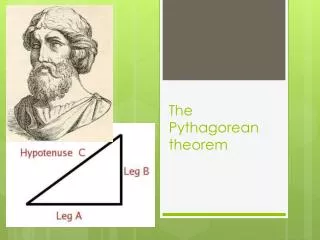
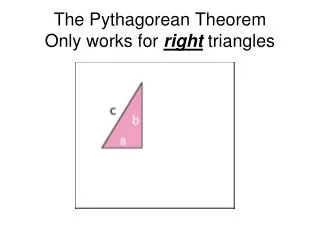
Notes hypotenuse c a b
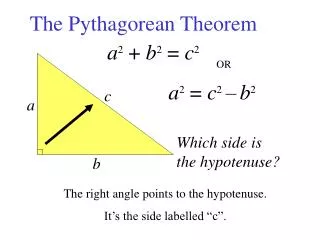
Notes On a right triangle, where c is the length of the hypotenuse, you can find missing lengths given two of them.
Using the Formula • a = 3, b = 4 c 3 4
Using the Formula • a = 6, b= 8 c 6 8
Using the Formula • a = 5 , b = 12
Using the Formula • a = 5, b = 6
What if You Are Given C? • a = 5, c = 13 13 5 b -25 -25
Using the Formula • b = 6 , c = 10
Using the Formula • a = 4 , c = 8
Using the Formula • a = 5 , c = 11
Closure • Mark is driving to the store and wants to take the shortest route. Use the picture below to determine the shortest route and give the distance. store 10 miles home library 24 miles