Download
1 / 13
130 likes | 227 Vues
Discover the methods for detecting planets in other star systems, including astrometric, radial velocity, occultation, and interferometry. Learn about the challenges and current limits in detecting Earth-like planets and the potential for finding life beyond our solar system.

E N D
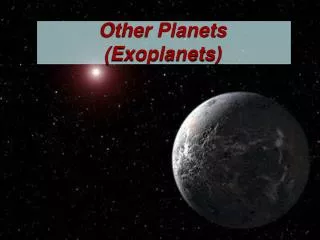
Detection of Extra Solar Planets • Planets are too faint to be observed by normal optical imaging • Several “indirect” approaches have allowed discovery of very large planets in other star systems. • There are nearly 70 extra solar planetary systems know know to exist.
Current Detection Methods • Astrometric • Radial Velocity • Occultation • Interferometery
Astrometric Detection • Early observers hoped to see a “wobble” in the motion of a star produced by the gravity interaction between the star and planet. The effect is probably too small to be observed from Earth.
Astrometric Detection • Early observers hoped to see a “wobble” in the motion of a star produced by the gravity interaction between the star and planet. The effect is probably too small to be observed from Earth.
Radial Velocity (Doppler) Detection • Spectra lines from a star will “shift” due to the wobble effect produced by the attractive force of a planet.
Radial Velocity (Doppler) Detection • Spectra lines from a star will “shift” due to the wobble effect produced by the gravitational force of a planet.
Radial Velocity (Doppler) Detection • Doppler (radial velocity) curve for the star 51 Pegasi. This is the first “normal” star discovered to have a planet.
Occultation Detection • Detection of the decrease in starlight intensity as a planet passes in from of the star. Venus occultating (transit) across the face of the sun
Occultation Detection • Detection of the decrease in starlight intensity as a planet passes in from of the star.
Current limits on detection • Only very large planets, orbiting close to their sun are detectible by the current methodologies. Earth-like planets are “invisible.”
Interferometer Detection • Two or more telescopes are used in tandem to obtain very precise position information for a star or produce and crude “image” of the planet Darwin Interferometeric telescopes