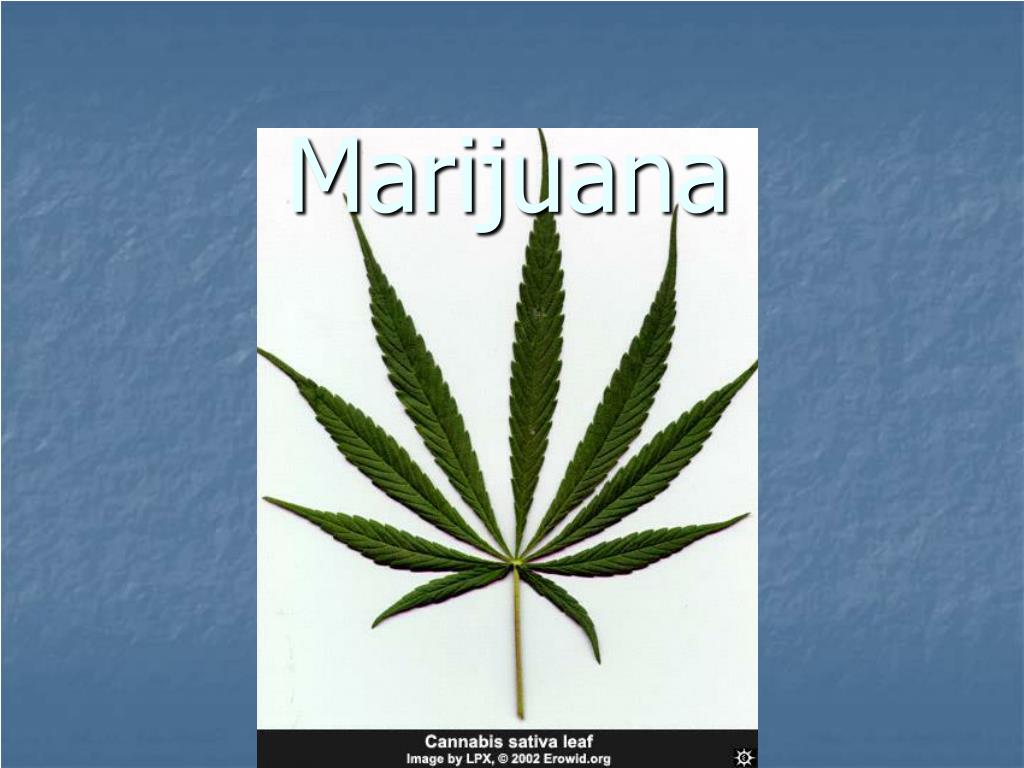
Marijuana
CANNABIS SPECIES • Cannabis sativa • grows worldwide • Tall plant with long, thin light green leaves • used for fibers to make cloth and rope, but also used for psychoactive properties. • Cannabis indica • Plentiful in Mideast, India, and Central Asia • Short plant with broad dark leaves • Mainly used for psychoactive resins. • Cannabis ruderalis • grows primarily in Eastern Europe (Russia, Poland) • Short weedy plant, less THC content than others
CANNABIS • Primary psychoactive agent in Cannabis • delta-9-tetrahydrocannabinol (THC) • Various preparations from Cannabis • Charas (in India) or Hashish • the pure resin from the leaves and stems • avg. concentration of THC is 3% to 7%, as high as 20% • Ganja (in India) or Sinsemilla (Spanish, without seeds) • dried tops of female plants (without seeds) • THC concentration 7 – 12% • Bhang • dried, ground up remainder of the plant • avg. concentration of THC is 1% to 2%
Early History of Cannabis • Cannabis probably originated in central Asia • Cultivated and widely dispersed before recorded history. • Scythians were probably responsible for spreading its use to Egypt and north to Europe and Russia. • In China, Cannabis probably known since ~4000 B.C. • Cultivated for fiber, seed, as well as intoxicating and medicinal properties. • Social use began in North Africa by ~1000 A.D.
Recent History of Cannabis Use • Widespread industrial use of hemp in western Europe and American colonies • psychoactive properties not widely recognized until 19th century • 19th Century: Romantic Literature and the New Science of Psychology • Use expanded into Europe and was widespread among artists and writers. • The new science of psychology also introduced the use and study of psychoactive agents.
HISTORY • “Marijuana, Assassin of Youth” • Sensationalized stories in the news media • e.g., blaming marijuana for violent crimes • 36 states in U.S. had laws regulating the use, sale and/or possession of marijuana by 1935. • The Marijuana Tax Act of 1937 • Did not outlaw Cannabis, but taxed it • After the Marijuana Tax Act • New York Academy study showed no physical or mental deterioration with long-term use.
PHARMACOLOGY • Cannabinoid Chemicals • Over 400 chemicals in marijuana • 61 unique to the cannabis plant • called cannabinoids • Pharmacokinetics • THC is a weak acid with a pKa of 10.6 • not ionized at pH of bodily fluids • When smoked, rapid absorption • Peak effects within 5-10 min. • When ingested, peak effects ~90 min. • Half-life ~ 19 hours, longer for metabolites (20-30 hrs) • Main metabolite: 11-hydroxy-delta-9-THC, which may be more active than delta-9-THC
NEUROPHARMACOLOGY • Mechanisms of Action • CB receptors discovered in brain, 1990 • CB1 receptors: in CNS • primarily in cortex, hippocampus, cerebellum, basal ganglia • CB2 receptors: spleen, immune system • Endocannabinoids were discovered soon after . • Anandamide, 2-arachidonylglycerol (2-AG) • Neuromodulators of multiple neurotransmitters, including monoamines, GABA, ACh and endorphins • Signaling between postsynaptic and presynaptic cells • Interactions with opioid peptides to modulate DA transmission in mesolimbic structures
Acute Physiological Effects • Cardiovascular and Peripheral Effects • Increased heart rate • Variable effects on blood pressure • Dry mouth, “bloodshot” eyes • Effects on Sleep • Drowsiness, increased sleep time • High doses can produce insomnia.
Cognitive/Behavioral Effects • Low to moderate doses produce euphoria, a pleasant state of relaxation, laughter • Some loss of coordination and balance • Simple reaction times relatively unaffected • Complex and choice reaction time, accuracy but not speed affected. • Impaired short-term memory • Reduced sustained attention • Impaired visuo-spatial and temporal processing
Adverse Behavioral Effects • Moderate to high doses may produce mild anxiety to panic and paranoia • A few rare cases have been reported of cannabis-induced psychoses, delusional and bizarre behavior, and hallucinations • These reactions occur most frequently in individuals who are under stress, anxious, depressed or borderline schizophrenic.
Driving Performance • The ability to perform complex tasks, such as driving, may be impaired while under the influence of marijuana. • Laboratory studies with non-regular marijuana users show significant impairments. • Results suggest that marijuana has little effect on ability to control a car, but impairs the driver’s ability to attend to peripheral stimuli. • Effects of THC on driving ability are amplified when combined with alcohol.
Critical Thinking Skills • Marijuana has been found to have a negative impact on critical thinking skills. • Impairment can affect: attention, memory, learning. • An unresolved question is whether these impairments are due to acute drug effects or long-term consequences of regular use.
Behavioral Effects in Nonhumans • Unconditioned Behavior • Biphasic effect on motor activity; initial increase, then depressant effects. • Stimulatory effects represent an exaggerated response to environmental stimuli. • High doses produce ataxia. • Reduced aggressive behavior • Conditioned Behavior • Interference with tasks that assess short term memory • THC decreases avoidance responding, like depressants • Unlike depressants, THC does not increase punished behavior.
Behavioral Effects in Nonhumans • Drug Discrimination • Rats readily learn to discriminate THC • Some evidence for partial generalization to depressants, but not to any other drug classes • THC discrimination is blocked by CB1 antagonists. • Self-Administration • Due to low solubility in water, I.V. self-administration of THC has been difficult to study. • Water soluble synthetic cannabinoids are self-administered. • THC also establishes Conditioned Place Preference in rats.
Health Risks • Abuse/Dependence Potential • Tolerance occurs when high levels are used over long periods. • Physical dependence has been observed under certain heavy use conditions. • Psychological dependence does not occur for most users, but can occur with frequent heavy use. • Withdrawal symptoms occur within 1 day and persist 4-12 days • Anxiety, restlessness, depression, irritability, disrupted sleep, decreased food intake, sometimes increased aggression
Health Risks • Chronic Lung Exposure • Similar chemicals to tobacco • Levels of exposure differ from tobacco • Marijuana as a causal factor in COPD or lung cancer is still debated • Reproductive Effects • Effects noted but significance not known • Immune System Effects • No relationship established between marijuana use and overall death rate
MEDICAL USES OF CANNABIS • China • First mention in 2737 B.C. was medical use • Cannabis mixed with wine was used for anesthetic 2900 years later (A.D. 200) • Europe • Almost no mention until 1800s • 1839, W.B. O’Shaughnessy reported on anticonvulsant and appetite stimulant effects. • Several publications followed regarding numerous other medical uses (e.g., tetanus, neuralgia, dysmenorrhea, asthma, gonorrhea, migraine, alcohol addiction).
MEDICAL USE OF CANNABIS • United States • Some early medicinal use in 1800s • Minimal uses until Marijuana Tax Act of 1937 resulted in withdrawal of existing products • Renewed interest following a 1972 report showed help for glaucoma patient and a 1975 report noted reduced nausea in chemotherapy patients.
MEDICAL USE OF CANNABIS • Suggested medical uses of marijuana include • Reduced intraocular pressure • Antiemetic • Appetite stimulant • Pain management • Reduced muscle spasticity • Recent developments with synthetic derivatives of THC (e.g., Marinol) and oral preparations from cannabis extracts (e.g., Savitex).