Understanding Matter: Elements, Compounds, and Mixtures in Chemistry
This guide explores the classification of matter, detailing differences between pure substances and mixtures. It defines elements—such as monatomic, diatomic, and polyatomic forms—and compounds, including ionic and molecular structures. We differentiate between homogeneous and heterogeneous mixtures, providing examples like oil-water separation and milk. The concept of phases in matter is explained, focusing on solutions, solvents, and solutes, with water as a universal solvent. This resource is essential for anyone looking to deepen their understanding of fundamental chemistry concepts.


Understanding Matter: Elements, Compounds, and Mixtures in Chemistry
E N D
Presentation Transcript
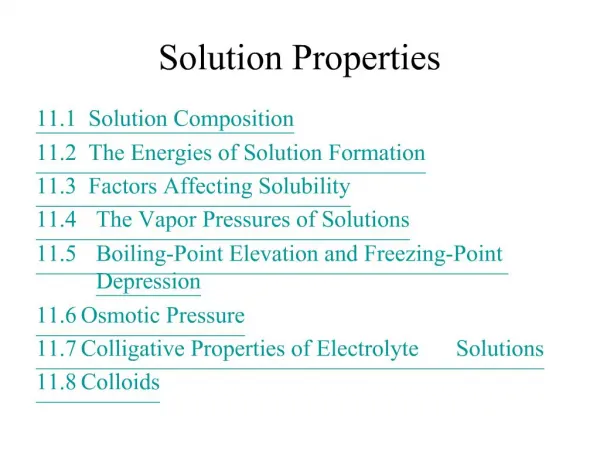
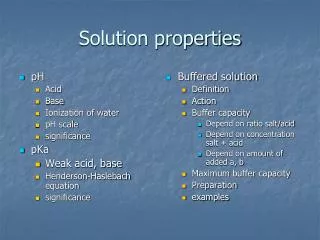
Solution properties
matter impure pure at least two substances one substance Elements compounds mixture mono-atomic:He Diatomic: O2 Polyatomic: Fe molecular ionic consist of ions NaCl consist of molecules H2O
matter impure pure at least two substances one substance mixture homogeneous heterogeneous two phases oil/water milk one phase Tab water solution
Phase region of physical uniformity all parts of that space have the same physical properties color, density, conductivity, magnetism, …
mixture homogeneous heterogeneous two phases oil/water milk one phase Tab water solution Solute(s) solvent • Less abundant or other component(s) of mixture • salts in tab water • more abundant • component of mixture • water in tab water • nitrogen in air Water always solvent even in 98% H2SO4