Download
1 / 15
150 likes | 280 Vues
This research explores the potential of genetic programming (GP) in automatically discovering numerical approximation formulae. It addresses the limitations faced in traditional numerical analysis and highlights the value of approximation methods across formal mathematics and industrial applications. The study evaluates the cost and error of approximations using a utility function and derives various candidates for approximating functions such as harmonic numbers and common mathematical functions. Results indicate that GP-evolved approximations demonstrate superior performance over Padé approximations, suggesting promising directions for future refinement and exploration.

E N D
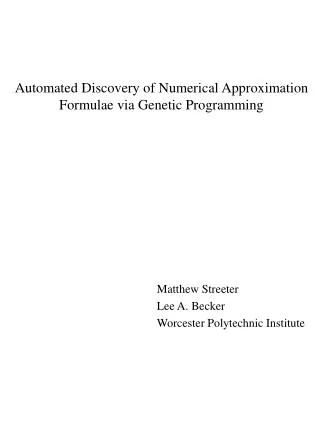
Automated Discovery of Numerical Approximation Formulae via Genetic Programming Matthew Streeter Lee A. Becker Worcester Polytechnic Institute
Motivations • Approximations have value in formal mathematics and industrial settings • Discovery of approximation formulae requires human insight or numerical analysis technique (f.e. Taylor series, Padé approximations) • Genetic programming provides general automated technique with potential improvement over existing methods
Evaluating Approximations • Given cost and error, utility function assigns value to an approximation • Reasonable utility function assigns higher value to approximations with lower error and cost • Pareto front represents set of approximations which are best under some reasonable utility function
Experimental Approach • Calculated cost of each expression by assigning fixed cost associated to each primitive operator • GP system returns Pareto front with respect to cost and error as result of a run • Used parameter settings from (Koza 1992) including populations size of 500, but with generation limit of 100 • Took combined Pareto front for population histories 50 independent runs
Rediscovery of Harmonic Number Approximations • Hn Sigma(i=1,n,1/i) • Asymptotic expansion: Hn = + ln(n) + 1/(2n) - 1/(12n2) + 1/(120n4) - . . . ( 0.57722) • Function set: {+, *, RCP, RLOG, SQRT, COS} • Fitness cases taken as first 50 points of Hn series • Candidate approximations simplified through Maple
Evolved Harmonic Number Approximations • Candidate solutions 8-10 are variations on first two terms of asymptotic expansion Terms of Asymptotic Expansion • Candidate solutions 2-7 are variations on first 3 terms • Euler’s constant discovered as: (RCP(SQRT(* 4.67956 RLOG(1.90146))))
Rational Polynomial Approximations to Functions of a Single Variable • Function set: {*,+,/,-} • Evolved approximations to 5 common functions: ln(x), sqrt(x), arcsinh(x), exp(-x), tanh(x) • Re-evaluated Pareto front through Maple cost and error procedures • Approximated over large interval to give evolutionary technique the advantage
f(x) = sqrt(x) f(x) = arcsinh(x) f(x) = exp(-x) f(x) = tanh(x)
Approximations of Functions of Multiple Variables • Possible to use single-variable techniques by combining and nesting approximations • This cannot be done for all functions, f.e. f(x,y) = x^y • Genetic programming used to evolve approximating surface for f(x,y) = x^y over area 0 <= x <= 1, 0 <= y <= 1
Target function: f(x,y) = x^y Evolved expression: f(x,y) = x/(y2+x-xy3)
Evolutionary Refinement of Approximations • New fitness formula: 1/(1+[error multiplier]*[error]) • Refined approximations evolved to sin(x) over interval [0, /2] • Refined 3 approximations whose error function looked simple • Original Pareto front contains 7 approximations; first 4 are refined
Summary and Conclusions • Rediscovered terms of asymptotic expansion for Harmonic numbers • For common mathematical functions approximated over a large interval, evolved solutions are superior to Padé approximations under some reasonable utility function • Evolved approximations can be refined • Evolved approximations for functions of multiple variables to which Padé approximation cannot be applied
Future Work • Iterative refinement, refinement of evolved approximations using numerical analysis technique & vice versa • Larger population size • Use of seed individuals corresponding to existing Padé approximations, Taylor series (see late-breaking paper, “Toward a Better Sine Wave”) • More recent GP features: automatically defined functions, architecture-altering operations • Ideal application would be to discover a genuinely new approximation formula