Download
1 / 9
90 likes | 218 Vues
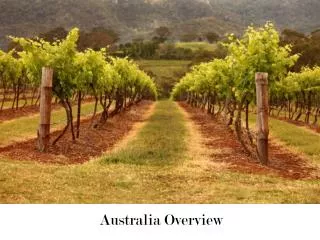
Australia ranks as the world's fourth largest wine exporter, producing around 750 million liters annually, with 40% consumed domestically. Boasting over 60 designated wine regions, primarily in its southern cooler parts, Australia has become known for its award-winning wines, particularly Shiraz, Cabernet Sauvignon, and Chardonnay. South Australia is recognized as the "wine capital," responsible for over half of the nation's wine production. Notable regions include Barossa Valley, Clare Valley, and McLaren Vale, each showcasing unique varietals and rich winemaking history.

E N D
Wine Regions • World's fourth largest exporter of wine with approximately 750 million liters a year • 40% of production consumed domestically • Australia has more than 60 designated wine regions across the country • Australia’s wine regions are mainly in the southern, cooler parts of the country • South Australia • New South Wales • Victoria • Western Australia • Tasmania • Queensland • Has developed a worldwide reputation for its award-winning wines • Major varietals: Shiraz, Cabernet Sauvignon, Chardonnay, Merlot, Semillon, Pinot noir, Riesling, and Sauvignon Blanc
South Australia • Known as “the wine capital of Australia” • Responsible for more than half the production of all Australian wine • Mediterranean climate with long summers, mild winters • Diversity in geography able to produce a range of grape varieties • Cool climate Riesling the Clare Valley • Big, full bodiedShiraz wines of the Barossa Valley • Includes famous regions such as: • Borossa* • Clare Valley* • McLaren Vale • The Adelaide Hills • Coonawarra
Barossa Valley • Home to some of the oldest continuously producing vineyards in the world • History of grape growing and winemaking dating back to 1842 • Incorporates both Barossa Valley and Eden Valley, making it one of the only areas with warm and cool climate growing conditions • Renowned for Shiraz – winning accolades around the globe • Other varieties such as Grenache, Cabernet Sauvignon, Mataro (Mourvedre), Riesling and Semillon • Riesling has gained an enviable reputation • Characteristic crisp citrus flavors • 2 types of soils: brown, loamy sandy to clay loam and sandy light-brownish grey to dark grey brown soils
Clare Valley • Settled in the 1840’s • One of the coolest mainland wine-growing regions in Australia • Most famous for crisp, complex Rieslings • Said to rival the great Rieslings of Mosel in Germany and Alsace • Principal red varieties: Cabernet Sauvignon and Shiraz • Wines are rapidly gaining an international reputation • Series of valleys and uplands with considerable variation in topography and microclimate • cool to cold nights and warm to hot summer days. • Soil structure varies throughout the valleys from red clays and sandy loams to the red loams over limestone • Producing only 3% of Australia's total grape crush • Wins 20% of the wine awards available to Australian vineyards every year
Victoria • East of Southern Australia • Smaller state that makes 15% of Australia’s wines • Established a reputation for its sweet, fortified wines made from late harvest grapes • Wine production ranges from rich, fortified dessert wines to delicate Pinot • 500+ wineries • Principal regions include: • Central Victoria* • North East Victoria • North West Victoria • Western Victoria • Port Phillip • Gippsland
Central Victoria • Most diverse region in the state • Known for its temperate climate and 500 million year old Cambrian soil • particularly well suited for producing deeply colored, rich Shiraz • Encompasses chilly mountain ranges, humid valley plains, fertile river flats, thick forests and dry, rolling hills • Produces wines that range from rich, ripe reds to full-flavored whites • Famous for: Rhone varietals, Shiraz, cool climate whites, and sparkling wines