Probability Calculation with Dice and Fortune Cookies
This article explores the mathematics of probability using examples of rolling two six-sided dice and distributing fortune cookies. We calculate the likelihood of certain outcomes, such as the probability that the sum of the dice is not 6 or is less than or equal to 9. Additionally, we tackle a real-life scenario involving the probability that among a group of five people, at least two will receive the same message from a set of 500 different fortune cookies. This comprehensive analysis illustrates the role of complements in probability calculations.

Probability Calculation with Dice and Fortune Cookies
E N D
Presentation Transcript
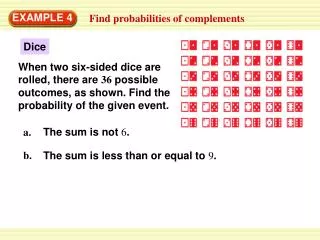
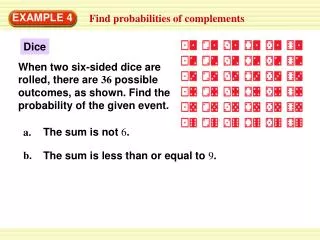
Dice When two six-sided dice are rolled, there are 36 possible outcomes, as shown. Find the probability of the given event. The sum is not 6. The sum is less than or equal to 9. EXAMPLE 4 Find probabilities of complements
P(sum is not 6) = 1 – P(sum is 6) 5 = 1 – 36 31 0.861 = 36 P(sum< 9) = 1 – P(sum > 9) 6 36 = 1– 30 = 36 5 0.833 = 6 EXAMPLE 4 Find probabilities of complements
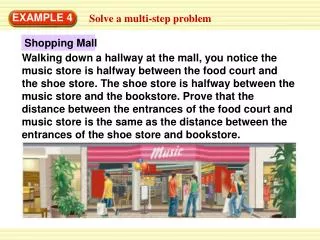
Fortune Cookies A restaurant gives a free fortune cookie to every guest. The restaurant claims there are 500 different messages hidden inside the fortune cookies. What is the probability that a group of 5 people receive at least 2 fortune cookies with the same message inside? The number of ways to give messages to the 5 people is 5005. The number of ways to give different messages to the 5 people is 500499498 497496. So, the probability that at least 2 of the 5 people have the same message is: EXAMPLE 5 Use a complement in real life SOLUTION
P(at least2are the same) = 1 – P(none are the same) 500499498 497496 = 1 – 5005 0.0199 EXAMPLE 5 Use a complement in real life
Find P( A ). P(A) = 0.45 0.55 ANSWER = for Examples 4 and 5 GUIDED PRACTICE
Find P( A ). 1 3 P(A) = 4 4 ANSWER = for Examples 4 and 5 GUIDED PRACTICE
Find P( A ). P(A) = 1 0 ANSWER for Examples 4 and 5 GUIDED PRACTICE
Find P( A ). P(A) = 0.03 0.97 ANSWER for Examples 4 and 5 GUIDED PRACTICE
ANSWER The probability increases to about 0.097. What If? In Example 5, how does the answer change if there are only 100 different messages hidden inside the fortune cookies? for Examples 4 and 5 GUIDED PRACTICE
ANSWER The probability increases to about 0.097. for Examples 4 and 5 GUIDED PRACTICE