Understanding Genetics and DNA: Key Concepts and Discoveries
This lecture outlines crucial topics in genetics and DNA, focusing on human genetics, chromosomal abnormalities, and DNA structure and replication. It explores significant experiments that led to the identification of DNA as the hereditary material and examines various syndromes resulting from nondisjunction of sex chromosomes. The lecture also highlights influential scientists, including Griffith, Hershey, Chase, Franklin, Watson, and Crick, and their contributions to our understanding of genetics. Prepare for quizzes based on chapters 13 and 14, as well as questions from the specified pages.

Understanding Genetics and DNA: Key Concepts and Discoveries
E N D
Presentation Transcript
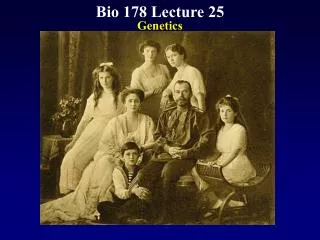
Bio 178 Lecture 27 Genetics and DNA
Reading • Chapters 13 & 14 ? Quiz Material • Questions on P 276-278 & 300 • Chapters 13 & 14 Quizzes on Text Website (www.mhhe.com/raven7)
Outline • Genetics • Human Genetics (cntd) • Chromosomes and Genetics • DNA • Experiments - DNA is hereditary material • DNA Structure • DNA Replication
Nondisjunction (Cntd.) • Nondisjunction of Sex Chromosomes Generally, the effects are not as severe as nondisjunction of autosomes. 1. X Chromosome (a) Triple X Syndrome Usually taller than average females, generally “normal” and most are *fertile. (b) Klinefelter Syndrome XX + Y XXY Sterile male with female characteristics and sometimes mildly impaired intelligence.
Klinefelter Syndrome http://www.carolguze.com/text/442-4-chromosome_abnormalities.shtml Klinefelter calico cat - evidence that Y chromosome determines maleness.
Nondisjunction of Sex Chromosomes (Cntd.) (c) Turner Syndrome (Monosomy X) X + O XO Short females with edema (resulting in webbed neck) that are almost always sterile. http://www.carolguze.com/text/442-4-chromosome_abnormalities.shtml
Nondisjunction of Sex Chromosomes (Cntd.) (d) OY O (egg) + Y OY Lethal - genes on the X chromosome are necessary for survival. 2. Y Chromosome X + YY (sperm) XYY Tall, fertile males. Genetic Counseling Read P 274.
Pedigree Example The above pedigree is for a rare kidney disease. Deduce the inheritance (autosomal, sex-linked, dominant, recessive).
Which Part of the Chromosome is Responsible for Heredity? • Scientific View up to 1940s 1. Human chromosomes are 60% protein. 2. Proteins are more heterogeneous than nucleic acids (20 amino acids compared to 2 bases). Genetic material assumed to be protein. • Griffith (1928) Hereditary material can be passed between cells (transformation). Read P 282.
Which Part of the Chromosome is the Genetic Material (Cntd.)? • Hershey and Chase (1952) DNA (not protein) is the hereditary material. Read P 283. Write a QHP for this experiment and hand in for extra credit.
What is the Structure of DNA? • Levene (1920s) DNA is a polymer of 5-C sugar, phosphate, & 4 bases (A, T, C, G). Believed bases in equal proportions. Read P 284-285. • Chargaff (1947) - Chargaff’s Rules (a) The amounts of the 4 bases are not equal. (b) A=T and C=G
What is the Structure of DNA (Cntd.)? • Franklin (1953) Method X-ray diffraction of DNA. Results (a) DNA is a double helix with a sugar-phosphate backbone. (b) Used the photographs to deduce the dimensions of DNA.
What is the Structure of DNA (Cntd.)? • Watson and Crick (1953) Method Built models to determine the structure of DNA (using Chargaff’s rules and Franklin’s data). Read Watson and Crick, 1953 and P 286-287.
How Does DNA Replicate? Complementarity suggested a copying mechanism. Eg. 5´-ACGTAAT-3´ pairs with 3´-TGCATTA-5´ There were 3 hypotheses: Conservative, dispersive, & semiconservative. • Meselson and Stahl (1958) The semiconservative hypothesis is correct. Read P 288-289 & predict what results would have been obtained for the other hypotheses (hand this in also).