Exploring the Foundations of Biology
Dive into the core aspects of biology, including properties of life, hierarchical organization, the scientific method, and unifying themes. Learn about how organisms function, the levels of organization, and the evolution of life forms.

Exploring the Foundations of Biology
E N D
Presentation Transcript
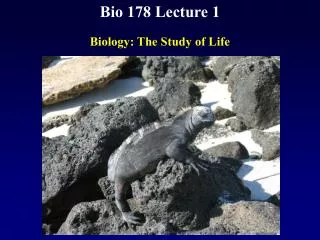
Bio 178 Lecture 1 Biology: The Study of Life
Reading • Chapter 1 ? Quiz Material • Questions on P18 • Chapter 1 Quiz on Text Website (www.mhhe.com/raven7)
Outline • Definition of Biology • Properties of Life • Hierarchical Organization • Scientific Method • Unifying Themes of Biology
What is Biology? The scientific study of organisms (living beings).
Properties of Life • Basic characteristics of living organisms • Cellular Organization • Order • Sensitivity • Growth, Development, and Reproduction • Energy Utilization (metabolism) • Evolutionary Adaptation • Homeostasis
Hierarchical Organization • Cellular level • Atoms • Molecules • Macromolecules • Organelles • Cells • Organismal level • Tissues • Organs • Organ systems • Organisms
Hierarchical Organization • Populational level • population • species • biological community • ecosystem • Emergent properties • Novel properties that arise at each higher level
The Scientific Method: The Hypothetico-Deductive Method Hypothesis - Tentative answer to a question (educated guess) Deductive - Deductive Reasoning Reasoning • Deductive Reasoning (Predictions) • Apply general principles to predict specific results • Eg. “If organisms are composed of cells (H1) & humans are organisms (H2), then humans are composed of cells (P)”. • Inductive reasoning • Use specific observations to construct general principles
Stages of a Scientific Investigation Observation Question Hypothesis(es) Prediction(s) Controlled Experiment Conclusion
How to Write QHPs Example 1: The laptop stops working. O: The laptop is not working Q: Why is the laptop not working? H: Example 2 (include a control): Asprins get rid of headaches. Q: Do asprins truly get rid of headaches? H: If asprins truly get rid of headaches, the headaches will clear FASTER if asprin is taken than if it is not. Controlled Experiment: Predictions: Conclusions:
A Few Definitions • An experiment is used to test a hypothesis, and/or eliminate one or more multiple hypotheses. • In a controlled experiment, all variables but one are kept constant in the experimental. In the control that variable is unaltered. • A theory is a hypothesis supported by a wealth of scientific evidence ( is a generally accepted principle).
Scientific Process OQ H P Controlled Experiments Conclusions Manuscript preparation for publication Peer Review Publication Replication by other scientists Acceptance by the scientific community
Example of the Development of a Theory: Evolution Accepted “Belief” in 1831: Species have been specifically created and are unchangeable over time. Darwin’s Evidence: Fossil record Geographical Distribution Islands Darwin’s Theory: Evolutionary changes occurring by the mechanism of natural selection are responsible for the diversity of life on earth.
Unifying Themes of Biology • Cell theory • Molecular basis of inheritance • Evolutionary change - Diversity • Evolutionary conservation - Successful structures are conserved
Unifying Themes in Biology Cell Theory Robert Hooke (1665): Discovered cells Schleiden and Schwann (1839): “All living things are composed of cells” Modern Cell Theory All living organisms are made of cells, and all living cells come from other living cells.
Unifying Themes of Biology • Molecular basis of inheritance • DNA encodes genes which make-up and control living organisms. Heredity is dependent on the faithful copying of the cell’s DNA into daughter cells. • Evolutionary conservation • Some fundamentally important characteristics of earlier organisms are preserved and passed on to future generations. Eg. Histones
Unifying Themes of Biology • Evolutionary change • Life-forms have evolved varying characteristics to adapt to varied environments. This has resulted in incredible diversity.