
Optimal Foraging Models and Human Fisheries Management
E N D
Presentation Transcript
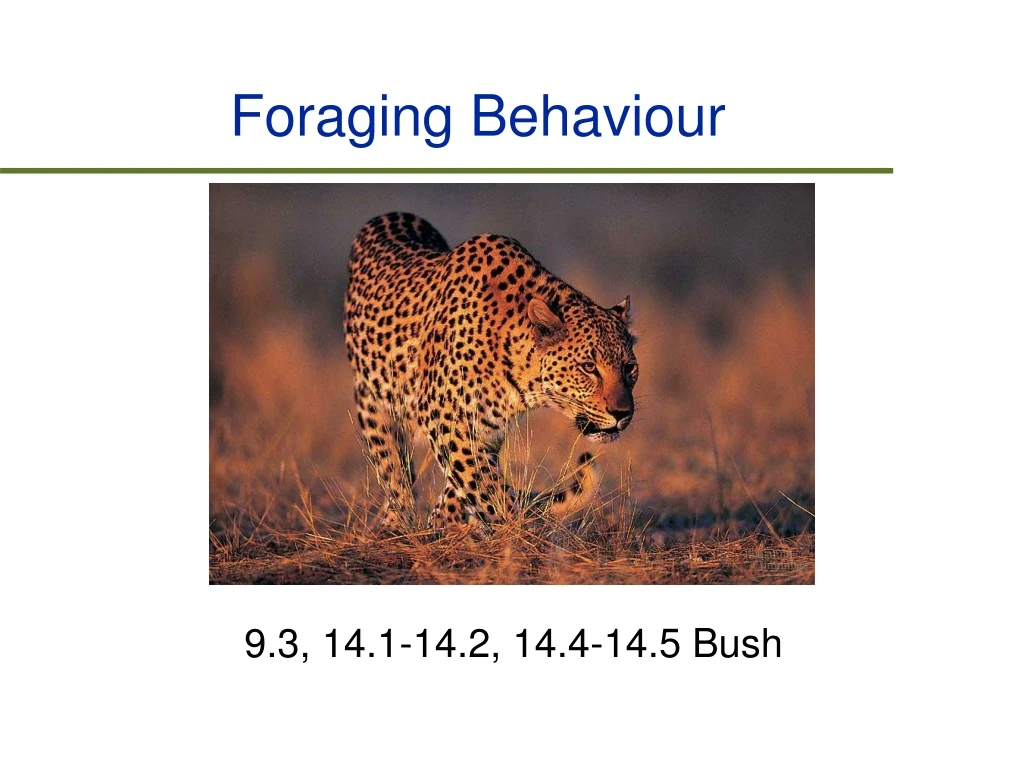
Foraging Behaviour 9.3, 14.1-14.2, 14.4-14.5 Bush
Outline • Optimal foraging models • The effect of prey and predator density • Human foraging and fisheries management
Outline • Optimal foraging models • The effect of prey and predator density • Human foraging and fisheries management
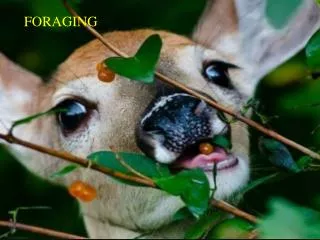
Foraging • One major activity of animals is foraging for nutrients and energy • What to eat, when and how? • food type • size/quality of prey items • energy/nutrient content • handling time • search time • presence of toxins • location of prey: mortality risk?
Maximizing energy gains • Optimal foraging maximizes energy gain per unit time • Rate of energy gain = (energy gained)/(time spent) • Energy gained (E) • is related to food quality (size, nutritional content, lack of toxins, etc.) • Time spent (T) • = expected searching time + handling time (pursuit, eating, digesting) • Should pick prey with maximal E/T (maximize rate of energy gain)
Foraging of the pied wagtail Even if larger prey are most abundant, the wagtail most frequently eats insects ~7 mm long.
Generalizations in optimal foraging • Searchers: • those that spend more energy on finding prey then on overcoming them, should be generalists • e.g. insectivorous birds • Handlers: • those that spend more energy on overcoming their prey, should be specialists as they will need specific adaptations for handling prey • e.g. wolves, lions
Howler monkeys - searchers • feed on fruits, flowers, & leaves of trees (96% species present in study area) • 25% of their time, they are foraging on the three rarest of species
Outline • Optimal foraging models • The effect of prey and predator density • Human foraging and fisheries management
The effects of prey density • Expected searching time is proportional to 1/prey density • Choice should depend on handling time, energy gain, and search time • Should be less choosy when prey are scarce: • widen diet breadth • Organisms should ignore poor food no matter how abundant it is and start eating it when preferred items get sufficiently rare
Stochastic food patches • Patches differ in food quality and quantity • Constant food sites may always provide a minimum amount for energy requirements while variable food sites may sometimes provide much more (or much less) • Yellow-eyed Juncos (Junco phaeonotus) switches from being 'risk-averse' (preferring constant food sites) to 'risk-prone' (choosing variable food sites) as starvation increased
Predation and optimal foraging • foraging is not just about eating, but about avoiding being eaten by your own predators • bluegill: doesn’t use habitat “optimally” from the point of view of energy gain, but combining energy gain and mortality risk gives a clearer picture • bluegills use habitat differently (“suboptimally”) when predators (pike) are present • balancing mortality vs. energy gain makes it harder to predict how animals should forage optimally • behavior like this creates indirect links in food webs: • presence of a top predator affects predator-prey relationships lower in the chain
Manifold influences of a predator species on a food web • Increasing eagle population might • decrease the fox population • change the behaviour of the fox population (may forage even more on rabbits and less on shrews)
Outline • Optimal foraging models • The effect of prey and predator density • Human foraging and fisheries management
Human foraging • We are a top predator in most communities and so our effects can trickle down the food chain and affect many lower trophic levels • Our foraging of fish fits well into optimal foraging models • We are very choosy with the seafood we like to eat • Switch our preferences only when our favorites are nearly extinct
Optimal Whale Foraging • Between 1920-1970, whalers targeted progressively smaller whales as large whales became too rare • First blue whales and humpbacks were harvested, then fin and humpback whales, then sei whales, then minke whales
Amount of fish caught • Fishing has steadily increased this century • Caused by: • Increase in human pop’n • Interest in healthy diet
Efficiency and large-scale fisheries • Economic efficiency: • Up to 100 tons of fish/$15,000 = $150 per ton • Up to 2 tons per $1000 profit = $500 per ton • Agricultural efficiency: • Ratio of energy expended versus energy obtained (calories)
Currency in human foraging • Optimal foraging theory is different for humans due to the fact that costs and benefits of searching for rare prey are different • If a fish species is highly desirable the price of it can go up (this does not occur in other species)
By-catch and its effects on fisheries • “By-catch” refers to species caught but not intentionally targeted by the fishery • Shrimp fisheries • have the highest by-catch:target ratio • 8-10 kg by-catch per 1kg shrimp caught • Some of this by-catch is red snapper, a fishery that has declined to 14% of its former size
Life history and fisheries • Some fish have opportunist life history while others have a competitive life history • The effect of fishing is lessened when our target is opportunist species (competitor species such as marlin, grouper, shark and halibut are in decline) • Our impact is never zero (e.g., cod are opportunist and have still crashed)
Other changes in fish populations • Not only are fish less numerous, they are also smaller in size • Fishers selectively target large fish, thereby reducing the reproductive output of the population
Eating our way down the food chain • Preferred fish are top predators • Top predators naturally have low population numbers • When top predator supplies are exhausted, we typically start fishing for a member of a lower trophic level
Fishery impacts on coral • Feeding down the food chain in the Caribbean has led there to be an increase in algae • Algae block the sunlight causing a shift in coral community towards fast-growing species
Water quality and fisheries • Chesapeake Bay Oysters control algal blooms by extracting plankton from the water • Overexploitation of oysters has caused their decline, resulting in far greater planktonic productivity • Algal blooms reduce the oxygen in the water, resulting in fish kills
General pattern of ecosystem decline • overexploitation of large top predators • influence on grazers reduces habitat structure (e.g.kelp/ sea grass or coral) • reduction of recruitment of fish species
Summary • Optimal foraging models indicate that species must forage to maximize energy gain and minimize time spent • Density of both lower and higher trophic levels alter the optimal foraging dynamics of a species • Human beings are optimally foraging on fish species in the world and are threatening their existence
Review • Next lecture – Film: “Why sex?” • Midterm is coming up! – Feb. 28th 6:30-8:30 PM, Rooms ST140 & ST 141 • Review questions are on the web! • Readings summary: • Chapters 1-4, 6-7, 9.3, 14.1-14.2,14.4-14.5, 17, 22.4-22.6 • I am available for questions/tutorials!