Prelude to War: The Rise of Aggression in Europe and Asia (1935-1937)
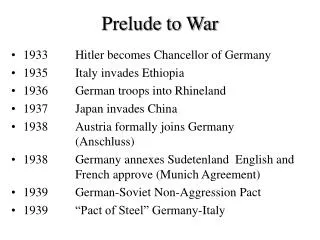
This analysis explores the key events leading up to World War II, focusing on Italy's invasion of Ethiopia in 1935, which faced minimal resistance from the League of Nations and the U.S. In 1936, Hitler's troops marched into the demilitarized Rhineland, defying the Treaty of Versailles. The Sudetenland was annexed with little pushback due to the appeasement strategies of France and Britain. Additionally, Japan's actions in 1937, including the invasion of China and the bombing of the U.S. gunboat Panay, highlight the escalating tensions that foreshadowed global conflict.


Prelude to War: The Rise of Aggression in Europe and Asia (1935-1937)
E N D
Presentation Transcript
Prelude to War Jake Mullins and Cody Cook
Italy • Invaded Ethiopia in 1935 • League of Nations & U.S. objected but took no action against Italy • Fighting lasted for a year
Germany • Hitler ordered troops into Rhineland in 1936, which was supposed to be demilitarized according to the Treaty of Versailles. • Hitler took Sudetenland with no resistance, after Roosevelt encouraged France and Great Britain to avoid conflict with Germany on the issue.
Japan • In 1937 Japan invaded China. • U.S gunboat Panay was bombed and sunk by Japanese planes • U.S Gov. quickly accepted Japan’s apology.