Reducing Patient Falls: A Quality Improvement Case Study
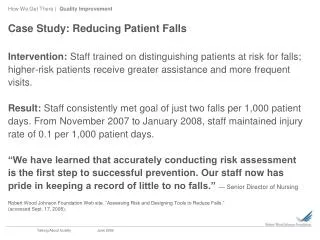
This case study highlights a quality improvement intervention aimed at reducing patient falls in a healthcare setting. By training staff to identify patients at risk for falls, higher-risk individuals received enhanced assistance and more frequent visits. As a result, the staff consistently achieved the goal of just two falls per 1,000 patient days from November 2007 to January 2008, maintaining an injury rate of only 0.1 per 1,000 patient days. The successful prevention strategy underscores the importance of accurate risk assessments and fosters staff pride in achieving positive outcomes.

Reducing Patient Falls: A Quality Improvement Case Study
E N D
Presentation Transcript
How We Get There | Quality Improvement • Case Study: Reducing Patient Falls • Intervention: Staff trained on distinguishing patients at risk for falls; higher-risk patients receive greater assistance and more frequent visits. • Result: Staff consistently met goal of just two falls per 1,000 patient days. From November 2007 to January 2008, staff maintained injury rate of 0.1 per 1,000 patient days. • “We have learned that accurately conducting risk assessment is the first step to successful prevention. Our staff now has pride in keeping a record of little to no falls.” — Senior Director of Nursing • Robert Wood Johnson Foundation Web site. “Assessing Risk and Designing Tools to Reduce Falls.” (accessed Sept. 17, 2008).