
The Interstellar Medium
E N D
Presentation Transcript
The Interstellar Medium Astronomy 315 Professor Lee Carkner Lecture 19
The Stuff Between the Stars • Called the interstellar medium (ISM) • Gas • Accounts for most of the volume • Dust • Account for most of the opacity
Gas • Modest amounts of C,N,O and other “medium” elements • Heavier elements have condensed to form the dust • How gas looks depends on the amount of external radiation
Radiation Environment • Amount of radiation depends on: • High mass O and B stars produce a lot of high energy radiation (UV) • The inner part of a dense cloud is shielded from most external radiation
Three Kinds of Hydrogen • Molecular clouds • Form where thick dust layers shield hydrogen • HI regions • Form where radiation is weak • HII regions • Form where there is a lot of radiation
Dust • If the ISM was all gas, you could see right through it • Dust particles are small (~1 micron = 1 millionth of a meter) • Some different types of dust: • Medium silicate grains • All these different types identified from complex absorption properties
What Does Dust Do? • Absorption • This causes interstellar extinction • Stars behind the cloud look fainter • Scattering • Dust scatters blue light better than red • Causes reddening (only red light gets through) • Stars behind the cloud look redder
Extinction • m = M + 5logd - 5 + A • A is the extinction • Can find the distance to a star if we know absolute (M) and apparent (m) magnitudes d = 10X X = (m-M+5-A)/5 • Remember d is in parsecs
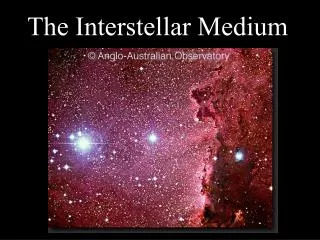
Nebulae • What is a nebula? • We now use the term to refer to any part of the ISM in general • There are three basic types of nebulae, each with a distinct appearance based on the way it interacts with light
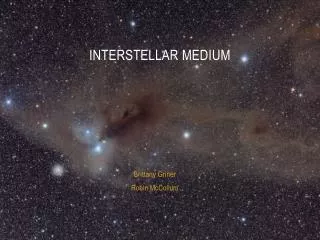
Dark Nebulae • Clouds that are dense with dust can completely block out the light of stars behind them • Can see stars in front of the cloud projected on it • Often associated with molecular clouds
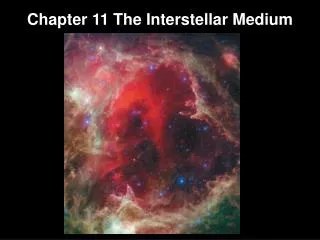
Emission Nebulae • If a cloud is near bright high mass stars it may shine as an emission nebula • The UV light ionizes the gas • Like a florescent light • The transitions are of the hydrogen Balmer series and so the nebula looks red or pink • Emission nebulae are HII regions
Reflection Nebulae • Dust preferentially scatters blue light • Same reason sky is blue • Need bright star fairly near-by to produce effect
Multiwavelength ISM • Radio • Neutral hydrogen emits at a wavelength of 21cm • Millimeter • For viewing molecular clouds • Some are very complex and must be protected from UV radiation
More Multiwavelength ISM • Infrared • Dust is cold (<100K or -150 C), and shines directly in IR • X-ray • For viewing coronal gas • Formed from supernova • Fills most of the space of the galaxy
Structure of ISM • We may be looking through many clouds when we view a star • The sun is actually in a large region of hot gas called the local bubble • The denser parts of the ISM are the sites of star formation
Next Time • Read Chapter 24.1-24.2