Operant conditioning
Learn about operant conditioning, reinforcement, punishment, Skinner, schedules of reinforcement, and how to modify behavior effectively. Discover the importance of consequences and the factors influencing behavior changes.

Operant conditioning
E N D
Presentation Transcript
Operant conditioning Zimbardo, P.G. & Johnson, R.L. & McCann, V. (2009). Learning and human nurture. In S. Frail (Ed.) Psychology: Core Concepts (pp. 91-114). (6th ed.) Boston, MA: Pearson Education, Inc.
Operant conditioning • Voluntary (not just reflexes = CC) • Reward and punishments • Consequences of behavior encourage or discourage behavior • Consequences = reward or punishment • More important than classical conditioning
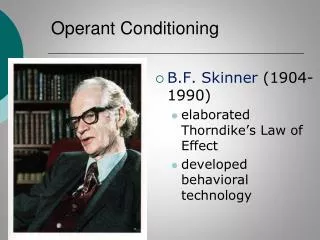
Behaviorism • Skinner - consequences • Thorndike – law of effect • dog in a box • Skinner uses law of effect but gets rid of ‘the mind’ = Radical behaviorism
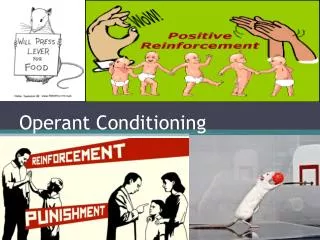
Reinforcement • Try to reinforce the behavior; you want the behavior to happen again, to be repeated: • Positive reinforcement • Negative reinforcement
Positive Reinforcement • Positive reinforcer follows and strengthens a response • food, money, sex • smile, praise • Positive reinforcement behavior will happen again
Negative Reinforcement • Negative reinforcer is taken away and strengthens the response • rain • noise • Negative reinforcement behavior will happen again • The Skinner box • Big Bang
Time and frequency of reinforcements • Crucial • Continuous reinforcement • Shaping – The Pony • Disadvantages: • Not always a reward for good behavior • Subject could get full • Experiment
Intermittent reinforcement • Not rewarding all correct responses • Already learned behavior • Social reinforcement – ‘Good dog’ • Resistance to extinction (2 slotmachines) • Schedules of reinforcement • Ratio – reinforcement after a certain number of responses • Interval – reinforcement after a certain time interval
Time and frequency of intermittent reinforcements • Fixed ratio • Variable ratio • Fixed interval • Variable interval
Ratio schedules • Fixed ratio (FR) • work faster • production • disadvantages? • Variable ratio (VR) • less predictable, very effective • telemarketing • slot machines
Interval schedules • Fixed interval (FI) • weekly quizzes • rats in a lab • paycheck (extension of a weekly contract) • Variable interval (VI) • random visits boss • pop quizzes • fishing
B.F. Skinner • Schedule of reinforcement • Ping Pong
Applied to a work situation • Which of these schedules of reinforcement is useful for what type of job? • Paycheck or supervision?
Primary and secondary reinforcers • Primary reinforcers • Secondary or conditioned reinforcers • How secondary reinforcers can become primary ones.
Biological base in operant conditioning • Biological base of operant conditioning • certain reinforcers (junk food) • instinctive drift Nature vs. Nurture • Humans and operant conditioning • Token economies
The Premack Principle • Desirable activities as a reinforcer • exercise • run around • Experiments • thirsty rats • exercise deprived rats
Reinforcement across cultures • What is a good reinforcer? • eating chocolate cake • taking away the noise of heavy metal music • going to the gym
Punishment • Discourage behavior • Opposite of reinforcement • positive punishment • Hotplate • Fingers between doors • Cut in your fingers • Using salt instead of sugar • negative punishment • Teenagers phone • No dessert
Punishment • Punishment has to change the behavior • Spanking • Speeding ticket • Behavior point deduction • Continuous (unlike reinforcement) • Employee comes in late (rewarding) • Different from negative reinforcement - Rat presses lever to turn off the loud sound - Rat presses lever and a loud sound starts
Punishment • Does punishment work? • What are the reasons of punishment? • Punishment or reinforcer?
Why do people punish? • It immediately changes behavior • Punisher may feel good But does it work in the long run?
Effective punishment = difficult • Threat goes away • Supervision • Police • Reward is bigger than the punishment • Dieting • Drugs
Effective punishment = difficult 3. Aggression and escape • Prison • Rats in a shock box • Aggression can be used to influence 4. Stops the learning process • Learned self-helplessness (depression) • Focus on what not to do
Effective punishment = difficult 5. Applied unequally • boys • children • minority groups Does punishment ever work? • Self-destructive behavior • Logical consequence
Effective punishment • Immediate • Consistent – every time • Limited time and intensity • Logical consequence of behavior – late for dinner eat dinner cold • Limited to the situation • No mixed messages ‘no hitting in this house’ • Negative punishment
Examples of Operant Conditioning • Lab rat • Big Bang
How to change behavior? • Positive reinforcement (Premack Principle) • Punishment • Negative reinforcement (nagging, allowed to come out of ‘time out’) • Extinction – ignoring the behavior • Combination!