Exploring the Timeless Tale of Cinderella: Culture and Morals in Folktales
The Cinderella story, with its many variations like "Yeh-Shen" and "Ashenputtel," highlights the universal themes of kindness, courage, and perseverance. As an enduring folktale, it offers insights into cultural values and moral lessons that resonate across generations. This narrative tradition showcases magical elements, relatable characters, and conflicts that ultimately reveal the triumph of good over evil. Join us as we delve into the rich world of folklore, the evolution of fairy tales, and how they teach lessons through entertaining stories.

Exploring the Timeless Tale of Cinderella: Culture and Morals in Folktales
E N D
Presentation Transcript
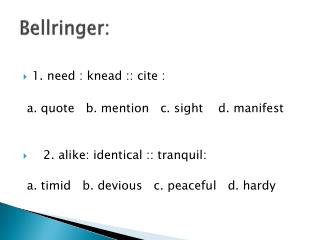
Bellringer: • 1. need : knead :: cite : a. quote b. mention c. sight d. manifest • 2. alike: identical :: tranquil: a. timid b. devious c. peaceful d. hardy
Cinderella: A Cultured Character Folktales Fairytales Fables
Genre: Folktales Subgenre: Fairytales Myths Legends Fables Parable
Folktale • A folktale is a story that was passed from generation to generation by word of mouth long before it was ever written. • Storytellers recount folktales, adding their own personal touches to entertain listeners and to teach a moral, or lesson.
Fairytale • Fairytales are stories with fairies or other magical creatures, and are usually written for children. • A modern fairy tale is written in a traditional style with the elements of folklore but with a contemporary twist.
Fable • Narration demonstrating a useful truth • Animals speak as humans • • Supernatural tales • • Morals or lessons are revealed and stated at • the end. • • Characters often have generic names such as • Dog, Rooster, Boy. • • Fable adaptations are now being published.
Motif • A recurring thematic element a story. • It could be a dominant theme or a central idea that is consistent throughout the genre.
Cinderella Ashenputtel Yeh-Shen Cinderella
Setting • The setting is where the story takes place. It can be a place that truly exists or an imaginary place.
Setting • Home • Paradise (literal or figurative) • Bad place – from which the protagonist tries to escape • Usually features a castle, forest, or a town.
Characters • Characters in folktalescan be people or talking animals who sometimes have extraordinary or magical abilities. • Good (nice) characters • Evil (mean) characters • Helper character – friend
Conflict and Resolution: • The conflicts are usually everyday problems that most people likely experience. • The resolution is always that good wins over evil.
Style • The style of a folktale is informal and conversational and reflects the culture of its origin. Stylistic Motif Begins with “Once upon a time” Ends with “…happily ever after”
Theme • The theme of a folktale, or the folktale's moral, is to teach a lesson or value.
Yeh-Shen • There are at least 900 versions of the Cinderella story.“Yeh-Shen” is, perhaps, the original story and it comes from China in 850-860 A.D. • Admirable traits for Chinese women: obedience and dependence. • Cultural characteristics in the story: shoe size. http://www.historyforkids.org/learn/china/clothing/
Cinderella • In 1697, Charles Pirrault authored a French version of the Cinderella story. This is the version that was later adapted by Disney and is the tale we are most familiar with today. • In this version, however, Cinderella intentionally left her slipper behind and the prince never sees her in “rags.”
Homework: • Read the German version of Cinderella, “Ashenputtel” by The Brothers Grimm. • As you read, identify three characteristics of a fairytale represented in the story and write your answers in your English binders. • Bring your textbook and your binders to class tomorrow.
Works Cited: • Rheinhart., & Holt, W. (2008). Elements of literature, first course (Teacher's ed). New York: Holt, Rhinehart, & Winston. • Disney collection . (n.d.). Thomas Kincade. Retrieved October 6, 2010, from www.thomaskinkade.com/magi/servlet/com.asucon.ebiz.catalog.web.tk.CatalogServlet?catalogAction=Product&productId=205258 • GenreCharacteristicsChart.pdf. (n.d.). uascentral. Retrieved October 6, 2010, from https://uascentral.uas.alaska.edu/onlinelib/Fall-2008/ED682-J01/GenreCharacteristicsChart.p • Adamson, A. (Director). (2003). Shrek (Full Screen Single Disc Edition) [Motion picture]. USA: Dreamworks Animated.