Revolutionizing Prosthetics: The MIT Knee and Next-Gen Biomechatronics
Explore the groundbreaking advancements in prosthetic technology with the MIT Knee's innovative design and functions. This comprehensive overview examines mechanisms of knee damping, stance and swing control, and virtual prosthetics that enhance user autonomy and mobility. Discover how intelligent applications of power and advanced actuators contribute to improved rehabilitation outcomes, leading to a more natural gait. Join us on a journey through the future of orthotics and prosthetics (O&P) as we unravel the science behind efficient, responsive leg systems.

Revolutionizing Prosthetics: The MIT Knee and Next-Gen Biomechatronics
E N D
Presentation Transcript
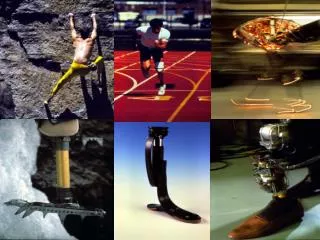
Otto Bock C-Leg Flex-Foot State Of The Art
State of the Art: Prosthetist defines knee damping Otto Bock C-Leg
Virtual Prosthetist Virtual Biomechanist The MIT Knee: A Step Towards Autonomy
How The MIT Knee Works: Mechanism
Knee Position Axial Force Bending Moment Measured Local to Knee Axis (no ankle or foot sensors) How The MIT Knee Works:Sensors Amputee can use vertical shock system
How the MIT Knee Works: Stance Control Goal: Early Stance Flexion & Extension
Stance Control: Three States • Stance Flexion & Stance Extension • A variable hydraulic damper • Damping scales with axial load • Late Stance • Minimize damping Toe-Loading to trigger late-stance zero damping is automatically adjusted by system
How the MIT Knee Works: Swing Control Goal: Control Peak Flexion Angle & Terminal Impact
Swing Phase: Extension Foot Contact Time Extension damping adaptation • Stage one: • Map tc versus impact force • Apply appropriate damping • Stage two: • Control final angle while minimizing impact force
1 0 -1 Human Knees Brake and Thrust Power (W/Kg) Percent Gait Cycle
Human Ankles are Smart Springs Leg stiffness control in walking and running humans Variable stiffness foot-ankle systems
Future of O&P Leg Systems: Intelligent Application of Power • Greater Distance & Less Fatigue • Natural Gait - Dynamic Cosmesis • Enhanced Stability • Increased Mobility
Human Rehab: A Road Map to the Future Better Power Systems and Actuators
Controlling Force, not Position Weight: 2.5 lbs. Stroke: 3 in. Max. Force: 300 lbs. Force Bandwidth: 30 Hz
Biomechatronics Group Hybrid Robots • Nearly autonomous • Controllable • Swam 0.5 body length per second
Human Rehab: A Road Map to the Future Improved Walking Models
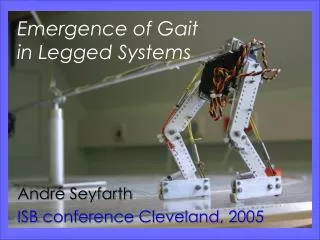
Low Stiffness Control: Virtual Model Control Language • Passive walkers work using physical components • Q: Can active walker algorithms be expressed using physical metaphors? • A: Yes, and they perform surprisingly well
Technology Science What are the biological models for human walking? Virtual Model Control Active O&P Leg Systems
Human Rehab: A Road Map to the Future Distributed Sensing and Intelligence
Virtual Prosthetist Virtual Biomechanist User Intent
Collaborators • Leg Laboratory • Gill Pratt • Biomechatronics Group • Robert Dennis (UM) • Nadia Rosenthal (MGH) • Richard Marsh (NE) • Spaulding Gait Laboratory • Casey Kerrigan • Pat Riley
Sponsors • Össur • DARPA • Schaeffer Foundation
Summary Advances in the science of legged locomotion, bioactuation, and sensing are necessary to step towards the next generation of O&P leg systems