Download
1 / 19
190 likes | 299 Vues
This analysis evaluates the Freeway Service Patrol (FSP) program in Chicago as a cost-effective solution to reduce highway congestion and improve traffic flow. Every year, congestion leads to significant costs, including over $87 billion for travelers. This report details methodologies for data collection, the functioning of emergency traffic patrol vehicles, and expected benefits such as vehicular delay savings, reduced fuel consumption, and enhanced road user security. With a low-cost operating model funded through state and local partnerships, the FSP shows potential for substantial economic benefits.

E N D
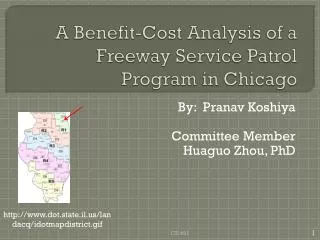
A Benefit-Cost Analysis of a Freeway Service Patrol Program in Chicago By: PranavKoshiya Committee Member Huaguo Zhou, PhD http://www.dot.state.il.us/landacq/idotmapdistrict.gif CE 491
Topics Background Freeway Service Patrol Emergency Traffic Patrol program (ETP) Methodology Data Collection and Assumptions Anticipated Results CE 491
Background • Highway congestion costs travelers more than $87 billion, 2.5 billion gallons of fuel and 4 billion hours annually (Urban Mobility Report, 2009) • Two types of congestion • Recurring: Congestion during peak periods of travel (commute hours) • Non-recurring: Congestion caused due to random events like, flat tires, crashes, disabled vehicles, etc..that cause reduction in freeway capacity • 60% of congestion on freeway • Solution • Recurring: TDM, TCM, Access Management, ITS • Non-recurring: Freeway Service Patrol CE 491
Freeway Service Patrol (FSP) • Fleet of vehicles that rove the freeway • They provide a low tech incident detection, response and removal system • Funding: • DOTs fund • DOTs contract it out to local agencies • Partial funding from DOT and Local Business (CVS Pharmacy) CE 491
Emergency Traffic Patrol (ETP) • The ETP Mission: Detect and quickly remove the incident from freeway • Consists of total 54 vehicles and covers over 1137 lane miles • Hours of operation and Charge • 24 hours, 7 days a week, 365 days a year • Free to public CE 491
Patrol Vehicles Patrol Truck Heavy Duty Truck Supervisor Truck CE 491
Emergency Traffic Patrol (ETP) • One of the oldest FSP program • Started in 1961 • Total motor assisted from 1961 to 2004: 3,389,655 CE 491
ETP Service Area for District 1 http://www.bing.com/maps/default.aspx?q=&mkt=en-US&FORM=BYFD CE 491
Benefits of ETP Program Vehicular delay savings Lesser fuel consumption Environmental Benefits Reduction in secondary accidents Increased security for road users CE 491
Methodology • Extensive field data collection • Use loop detectors • Freeway Service Patrol Evaluation Version 12.1 (FSPE) • Developed by University of California at Berkeley • Uses MS-Excel for all inputs and outputs • User friendly and convenient to use CE 491
FSPE Inputs • Inputs • Cost of ETP • Freeway segment characteristics • Traffic Volumes • Incidents CE 491
Costs of ETP • Depends on • Number of patrolling trucks • Service hours • Coverage miles • Capital, Administrative and Operating • Cost per truck hour is between $22 to $88 CE 491
Freeway segment characteristics A Freeway B • Beat Design • Length (Miles) • Number of Lanes • AADT – Average Annual Daily Traffic • Directional Factors • Hourly traffic volumes CE 491
Incidents • Divide into three categories • Accident • Breakdown • Flat tires, Fuel, Jump start, and Minor repairs • Debris CE 491
Assumptions • Default freeway capacity: 2,100 pcphpl • Free flow speed: 55 mph • Response times without ETP: 30 minutes • Average speed of patrolling trucks: 30 mph • Average fuel cost in 2009: $2.32 per gallon (AAA) • Estimated $15.47 per hour of person travel and $102.12 per hour of truck time (Urban Mobility Report, 2009) CE 491
Capacity Reduction CE 491
Beat One: Eden’s (I-94) Result Annual delay savings: 72,829 veh-hours Annual fuel savings: 109,857 gallons B/C Ratio: 20.26:1 CE 491
Anticipated Results Annual delay savings (veh-hours) Annual fuel savings (gallons) Overall B/C Ratio CE 491
Questions CE 491