Understanding Death and Afterlife in Ancient Egyptian Beliefs
Ancient Egyptians held a rich tapestry of beliefs surrounding death and the afterlife. Their polytheistic worldview encompassed gods who cared for both daily life and the realm of the dead. Central to their beliefs was the notion that the body housed three souls: 'ka', 'ba', and 'akh', all crucial for a successful journey to the afterlife. The preservation of the physical body through mummification and elaborate burials, such as pyramids filled with offerings, ensured eternal life. These practices highlight the profound differences and similarities in how cultures approach death, offering valuable insights into humanity’s quest for understanding mortality.

Understanding Death and Afterlife in Ancient Egyptian Beliefs
E N D
Presentation Transcript
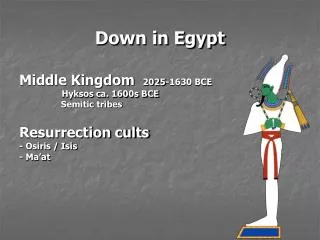
Religious beliefs • Polytheistic • Some of the gods looked after matters of daily importance and others governed the realms of the dead • believed the body contained three souls, ‘ka’, ‘ba’ and ‘akh’ • would be reunited in the next world if the physical body remained in tact • The dead could only fully appreciate eternity, it was thought, if they remained corporally complete • The afterlife would be an enhancement of their earthly life
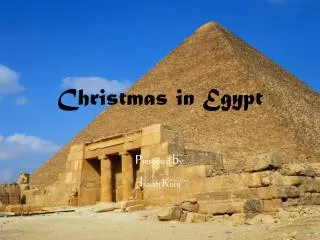
Burial • Pyramids served as tombs for pharaohs and kings • tombs were filled with food and drink, instructive texts, games, and jewelry, which would follow them into the afterlife • Texts, written on the tombs were thought to help the inhabitant to thrive • Shabtis • Model figures buried with the dead which provided friendship for the deceased and acted as their laborers
Mummification • Before the dead reached the next world, they were led to a judgment hall by Anubis, the god of mummification • Their heart, containing evidence of their behavior in life, was then weighed against a feather • If their heart outweighed the feather it was heavy with the guilt of a life badly lived and was then eaten by Ammit, the creature combined of a crocodile, a lion, and hippopotamus • If the feather weighed more than the heart, the heart was thought to be pure and the owner made their way into the next life
Open mouth ceremony • believed that ritual existed which would bring sensory life back to the deceased’s form, enabling it to see, smell, breathe, hear, and eat, and thus partake of the offering foods and drinks brought to the tomb each day • symbolic re-enactment of the clearing of a baby’s mouth at birth • earliest implements used were probably the priests’ fingers, later replaced by finger-shaped iron blades. • The adze(made from the “metal of heaven,” an arched metal blade fasted across the top of a wooden handle with leather tongs used in woodworking) was touched to the lips by the officiating priest
United States Vs. Egypt • Christians believe in Heaven, Egyptians believe in the afterlife • We visit the gravesite every once in a while, where Egyptians made it a point to regularly visit the body • They bring food, statues, jewelry, etc. • We bring flowers, decorations, etc. • We generally mourn in the event of a death, while they celebrate the passing into the afterlife • We similarly console ourselves with the thought that “they are in a better place”