

SlideServe
Menu
Préférences
© SlideServe · v2026

Acids and Alkalis

selene avatar
17 diapositives · 2.4K Views · Oct 14, 2014

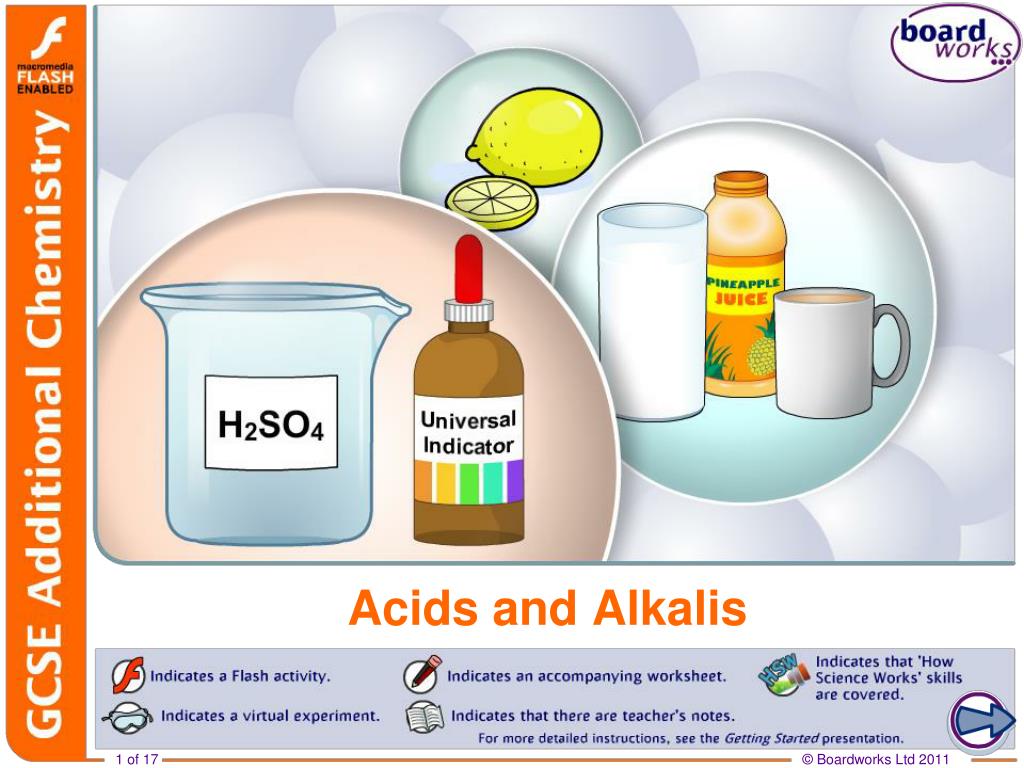
Acids and Alkalis. What are acids and alkalis?. What are bases?. All alkalis are bases . Bases are substances that react with acids by absorbing hydrogen ions ( H + ). The oxides, hydroxides and carbonates of metals, such as sodium hydroxide, are bases.
Acids and Alkalis - slide 1
01 / 17Acids and Alkalis
1 / 17

Télécharger la présentation

Acids and Alkalis
Une image / un lien ci-dessous est fourni (tel quel) pour télécharger la présentation

Politique de téléchargement : le contenu du site vous est fourni TEL QUEL pour votre information et votre usage personnel ; il ne peut être vendu, concédé sous licence ni partagé sur d’autres sites sans l’accord de son auteur.Le contenu vous est fourni TEL QUEL, pour votre information et votre usage personnel uniquement. Téléchargez la présentation en cliquant sur ce lien. Lors du téléchargement, si vous ne parvenez pas à télécharger une présentation, l’éditeur a peut-être supprimé le fichier de son serveur.Pendant le téléchargement, si vous ne parvenez pas à obtenir une présentation, le fichier a peut-être été supprimé par l’éditeur.

F I N

Plus de contenu associé

Transcription de la présentation
  1. Acids and Alkalis

  2. What are acids and alkalis?

  3. What are bases? All alkalis are bases. Bases are substances that react with acids by absorbing hydrogen ions (H+). The oxides, hydroxides and carbonates of metals, such as sodium hydroxide, are bases. Some bases are soluble in water. These are called alkalis. All alkalis contain hydroxide ions (OH–). The more OH– ions in the solution, the stronger the alkali.

  4. What are indicators? Indicators are chemicals that change colour in the presence of an acid or an alkali. There are many different indicators. Lots of them come from plants, like red cabbage. Different indicators turn different colours. Geranium plants grown in acidic soil have red flowers, while geraniums grown in alkali soil have blue flowers. Universal indicator is a mixture of indicators. It is useful because it shows a range of colours from pH 1–14.

  5. 1 2 3 4 5 6 7 8 9 10 11 12 13 14 What does the pH scale show? The pH scale runs from 1 to 14. The numbers 1 to 6 represent acidic conditions and 8 to 14 represent alkali conditions. A pH value 7 is neutral. What are the pH values of some everyday items?

  6. What does the pH scale show?

  7. What is the order of pH?

  8. Acids and bases – true or false?

  9. Making salts

  10. pH change during neutralization

  11. + + acid base  salt water How are salts made and named? When an acid reacts with a base, a neutralization reaction occurs and produces a chemical called a salt. The name of the salt depends on the names of the reactants. • The first part of the salt’s name comes from the metal in the base: e.g. sodium hydroxide sodium…  • The second part of the salt’s name comes from the acid: e.g. sulfuric acid …sulfate  For example, if sodium hydroxide neutralizes sulfuric acid, the product is a salt called sodium sulfate.

  12. Naming salts

  13. Making salts with an acid and an alkali When an acid reacts with an alkali, H+ ions from the acid and OH- ions from the alkali combine to produce a salt and water. Water is formed because the oxygen and hydrogen from the alkali react with the hydrogen from the acid to produce molecules of water (H2O). For example: hydrochloricacid sodiumhydroxide sodiumchloride + +  water + +  HCl (aq) NaOH(aq) NaCl (aq) H2O (l)

  14. Glossary

  15. Multiple-choice quiz