Download
1 / 8
90 likes | 232 Vues
Community Courts represent a proactive approach to justice, addressing not just the volume of cases but their nature. Established first in Manhattan, these innovative courts are spreading globally, aiming to solve underlying community issues and reduce recidivism. By engaging offenders in treatment programs and fostering community support, they ensure accountability while rebuilding neighborhoods. With principles centered on restoration, partnerships, and problem-solving, Community Courts are revolutionizing how justice is perceived and delivered in urban areas, enhancing safety and community trust.

E N D
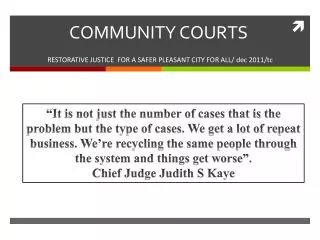
COMMUNITY COURTS RESTORATIVE JUSTICE FOR A SAFER PLEASANT CITY FOR ALL/ dec 2011/tc “It is not just the number of cases that is the problem but the type of cases. We get a lot of repeat business. We’re recycling the same people through the system and things get worse”. Chief Judge Judith S Kaye
COMMUNITY COURTS RESTORATIVE JUSTICE FOR A SAFER PLEASANT CITY FOR ALL/ dec 2011/tc “The options open to a District Court judge in the present system are limited. The present system cannot be said to be proactive in dealing with the underlying problems that offenders may have prior to a final order being made -----the court cannot be proactive in monitoring compliance” The case for Community Courts in Ireland----Judge Michael Reilly
COMMUNITY COURTS RESTORATIVE JUSTICE FOR A SAFER PLEASANT CITY FOR ALL/ dec 2011/tc The first Community Court was set up in Midtown, Manhattan, New York. (1991) Now Community Courts are operating around the world in Sweden, Netherlands, South Africa, England, Northern Ireland
COMMUNITY COURTS RESTORATIVE JUSTICE FOR A SAFER PLEASANT CITY FOR ALL/ dec 2011/tc Community Courts are neighbourhood-based courts that attempt to harness the power of the justice system to address local problems. They help build stronger, safer neighbourhoods. They have problem solving judges dedicated to each Community Court. Offenders must plead guilty to participate in the proccess.
COMMUNITY COURTS RESTORATIVE JUSTICE FOR A SAFER PLEASANT CITY FOR ALL/ dec 2011/tc Community Courts are guided by four basic principles: Restoring the Community, Bridging the gap between Communities and Courts, Building Partnerships, Solving Problems.
COMMUNITY COURTS RESTORATIVE JUSTICE FOR A SAFER PLEASANT CITY FOR ALL/ dec 2011/tc Do Community Courts work? Where offenders (Manhattan) completed over 90 days of court ordered treatment under the supervision of a problem solving judge the compliance rate was 75% and reoffending dropped by 63%
COMMUNITY COURTS RESTORATIVE JUSTICE FOR A SAFER PLEASANT CITY FOR ALL/ dec 2011/tc When Courts release offenders with no sanction – when the process becomes the punishement – they send out the wrong message to offenders, victims, the police, and the community including residents. The message is that nobody cares, and that the justice system is little more than a set of revolving doors.
COMMUNITY COURTS RESTORATIVE JUSTICE FOR A SAFER PLEASANT CITY FOR ALL/ dec 2011/tc Dublin is one of the safest cities in the world, but our street climate needs to be better. Community Courts are a positive way forward.