Understanding Sampling, Statistical Inference, and Polling Design Principles
This material covers crucial concepts in statistical sampling, correlation, and linear regression, along with the foundations of statistical inference. Key topics include the importance of representative samples, differences between probability and non-probability sampling, and the impact on polling accuracy. Assignments due on 11/29 will test your understanding of these principles, while the final exam is scheduled for December 11-12. Students will engage in discussions about research design, critical analysis of polling techniques, and the significance of reliable data collection methods.

Understanding Sampling, Statistical Inference, and Polling Design Principles
E N D
Presentation Transcript
Sampling 11/29/2012
Readings • Chapter 8 Correlation and Linear Regression (Pollock) (pp 199- 206) • Chapter 6 Foundations of Statistical Inference (Pollock) (pp 122-135)
Homework Due Today • Homework Due 11/29 • Chapter 8 • Question 1: A, B,C,D • Question 2: A, B, C, D, E • Question 3: A, B, C • Question 4: A, B, C, D • Question 5: A, B, C, D, E, G
Final Exam • SEC 1 • December 12th (Wednesday) • 1:30 pm - 3:30 pm • SEC 2 • December 11th (Tuesday) • 1:30 pm - 3:30 pm
Final Paper • Due 12/7/2012 by 11:00AM- Doyle 226B • Turnitin Copy by 11:59PM on 12/7
Office Hours For the Week • When • Friday 11-1 • Monday 11-1 • Tuesday 8-12 • And by appointment
Course Learning Objectives • Students will learn the basics of polling and be able to analyze and explain polling and survey data • Students will learn the basics of research design and be able to critically analyze the advantages and disadvantages of different types of design.
Question Reliability and Validity • People Must see value • Pre-Test • Pilot Test
Sampling After we write the survey, we have to select people!
The Laws of Sampling • if cost is not a major consideration it is better to collect data for ones target population than for a sample thereof • if cost dictates that a sample be drawn, a probability sample is usually preferable to a nonprobability sample. • The Law of Large Numbers • The accuracy of estimates is expressed in terms of the margin or error and the confidence level. • all probability samples yield estimates of the target population.
What is a population A Population Is the census A population? The Census includes 225 Million Adults Cost 11.8 billion dollars Takes years to compile Misses out on millions and is obsolete before it is published • The responses of every unit in your group • 50 states • Every student, etc • There is no “sample” error here
The Source of Public Opinion Sampling
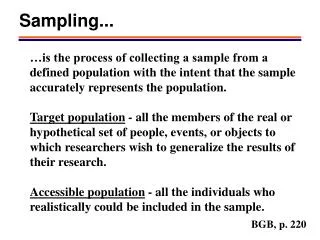
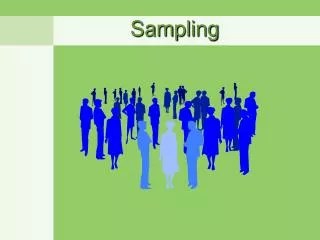
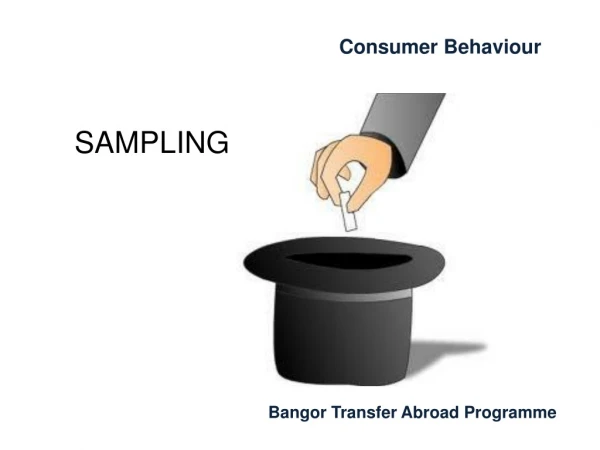
What is Sampling? • Sampling is the technique of selecting a representative part of a population to estimate the total population
The Sample • A sample is considerably smaller than the total population. • Samples that are said to mirror the population are said to be representative.
These Numbers Have to be drawn properly… or it is not representative
The Concept of Sampling • Blood Tests • Food Tests
Collecting a sample • Population • Sampling Frame • The Sample itself
The Practicality of Sampling • Time • Money • Accuracy
If cost dictates that a sample be drawn, a probability sample is usually preferable to a nonprobability sample.
Why? Non-Probability Samples
Probability vs. Non Probability • Probability- Every Unit Has a Chance of Being Selected • Also called a random sample • Non-Probability- some units have a greater chance of selection • Usually not generalizable
Why Non-Probability • Very Fast • Very cheap • Difficult Populations to reach • Exploration
Business Uses this Extensively • Get the Product out • Focus Groups (5:48) • Alternate endings • Test audiences • If it works, you expand
Self Selected Samples • People Choose to Be in the Sample • Classic Sanjaya • Certain people have much more incentive to participate
Straight-up Internet Surveys • These are self-selected • Big numbers mean nothing
The Literary Digest in 1936 • Correct in 24,28,32 • 10 million ballots distributed • 2.2 Million Responses • Alf Landon Will defeat FDR (by a landslide)
Why The Literary Digest was Wrong • The wrong sampling frame • Response bias • The Literary Digest goes out of business
Convenience Samples • Super-Fast • Pick easy targets
Quota/Judgment Samples • Find People who Match your criteria • The Price is Right • Easy, but Not random… not representative
Quota Samples • A Type of Judgment Sample • Break the nation into groups • Pick a certain number/quota from each group • Stop when you have filled up your quota
The Death of Quota Sampling: 1948 • We used to use these for national polls • George Gallup thrived on these. • In 1948 he predicts that Thomas Dewey of New York would defeat Harry Truman
Why Gallup was Wrong • It was a close election • The electorate diversified (missed out on groups) • They filled up quotas with easy targets • They stopped polling
Snowball Sample • one becomes two, becomes four, becomes 8 • Difficult to Reach Populations • Background Checks
Looking through A Parent’s eyes The Most Beautiful Kids Ever Internal Polling