Pedigree Charts: Genetics Family Tree Analysis
190 likes | 322 Vues
Explore the importance of pedigree charts in genetic history. Learn how to interpret symbols, identify generations, and understand inheritance patterns of diseases. Examples provided for better comprehension.


Pedigree Charts: Genetics Family Tree Analysis
E N D
Presentation Transcript
Pedigree Charts The family tree of genetics
What is a Pedigree? • A pedigree is a chart of the genetic history of family over several generations. • Scientists or a genetic counselor would find out about your family history and make this chart to analyze.
Male Female Constructing a Pedigree
Connecting Pedigree Symbols Examples of connected symbols: • Married Couple • Children
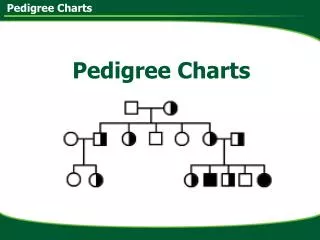
Example • What does a pedigree chart look like?
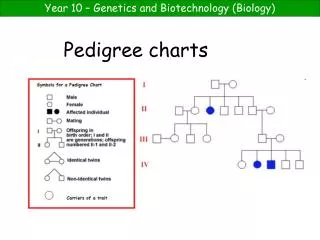
Symbols used in pedigree charts • Normal male • Affected male • Normal female • Affected female • Marriage
Organising the pedigree chart • A pedigree chart of a family showing 20 individuals
I II III IV Organising the pedigree chart • Generations are identified by Roman numerals
I II III IV Organising the pedigree chart • Individuals in each generation are identified by Arabic numerals numbered from the left • Therefore the affected individuals are II3, IV2 and IV3
Interpreting a Pedigree Chart • Determine if the pedigree chart shows an autosomal or X-linked disease. • If most of the males in the pedigree are affected the disorder is X-linked • If it is a 50/50 ratio between men and women the disorder is autosomal.
Example of Pedigree Charts • Is it Autosomal or X-linked?
Answer • Autosomal
Interpreting a Pedigree Chart • Determine whether the disorder is dominant or recessive. • If the disorder is dominant, one of the parents must have the disorder. • If the disorder is recessive, neither parent has to have the disorder because they can be heterozygous.
Example of Pedigree Charts • Dominant or Recessive?
Answer • Dominant
Example of Pedigree Charts • Dominant or Recessive?
Answer • Recessive
Summary • Pedigrees are family trees that explain your genetic history. • Pedigrees are used to find out the probability of a child having a disorder in a particular family. • To begin to interpret a pedigree, determine if the disease or condition is autosomal or X-linked and dominant or recessive.