Download
1 / 20
200 likes | 293 Vues
Explore the effects of canopy expansion on chromospheric evaporation through a simulation model. Investigate the role of thermal conduction fronts in plasma heating and plasma motion in flare loop dynamics. The study examines the expansion of the canopy and its implications on the location of the nozzle relative to the Transition Region.

E N D
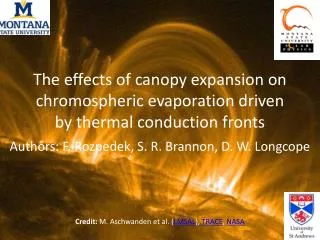
The effects of canopy expansion on chromospheric evaporation driven by thermal conduction fronts Authors: F. Rozpedek, S. R. Brannon, D. W. Longcope Credit: M. Aschwanden et al. (LMSAL), TRACE, NASA
Flare loop dynamics Reconnection frees loop to contract RD accels plasma Simulation region RD RD GDS GDS GDS heats plasma to flare temp. @ loop top Chromosphere ~90% free mag. energy => bulk plasma motion (Longcope et al. 2009)
Chromosphere T=0.01 Trans. Reg. (TR) Corona T=1 Post-shock Fluid input Ms Mp GDS Uniform pressure in TR 1-D “shocktube” model • Model details: • Static non-uniform grid: • <1 km (chromosphere), ~10 km (corona), scales up in TR • Include viscosity & Spitzer conductivity • Neglect gravity & explicit radiative effects • Simplified model atmosphere: temp. grad. @ const. pressure • Classical piston shock (tanhfunc. w/ Rankine-Hugoniot)
Model loop atmosphere Chromosphere TR Corona
Time Evolution for the uniform tube E C C TCF E
Time Evolution for the uniform tube E C C E TCF
The canopy expansion A C B Question: Is there some observational quantity that would enable us to determine where the nozzle is located relative to the Transition Region? ? TR ?
Varying Area Profile Thermal Conduction Front Thermal Conduction Front Thermal Conduction Front Nozzle at the centre of the TR Nozzle below the TR Nozzle above the TR The area profile has a form of a piecewise linear function.
Transsonic points (lower) (upper)
Transsonic points (lower) (upper)