Exploring Mirrors and Lenses: Reflection, Refraction, and Vision Correction
This brief overview highlights the fundamental principles of mirrors and lenses, showcasing the law of reflection and how different mirror types—plane, concave, and convex—affect image characteristics. It also delves into lens types, including convex and concave lenses, explaining their functions in refracting light and correcting vision issues like nearsightedness and farsightedness. Practical examples, such as bathroom mirrors and magnifying glasses, illustrate these concepts, making the science of optics accessible and engaging.

Exploring Mirrors and Lenses: Reflection, Refraction, and Vision Correction
E N D
Presentation Transcript
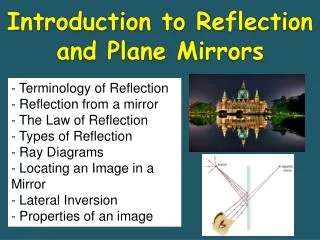
Law of Reflection • Angle of incidence equals the angle of reflection • Whatever angle the light hits the surface, it will bounce back at the same angle
However….. ….the shape of the reflecting surface affects the way light reflects from it
Plane Mirror • Has a flat surface • Reflection is upright and same size • Images are reversed • Examples: bathroom mirror, rearview mirror in a car
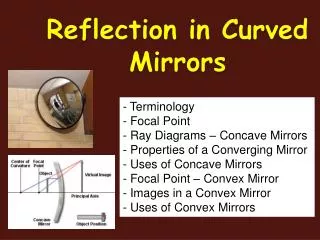
Concave Mirror • Curved inward • If the object is close to the mirror, the image is enlarged and upright • If the object is far away, the image is reduced in size and upside down • Examples: inside of a spoon, reflecting telescope, inside of a flashlight
Convex Mirror • Curves outward • The image is upright and smaller • Useful because they allow you to see a large area • Examples: side mirrors on cars, back of a spoon, used for security
Convex Lens • Thicker in the middle than at the edges • Light refracts towards the center (converges) • Examples: magnifying glasses, human eye, cameras, projectors
Concave Lens • Thinner in the middle than at the edges • Light spreads out (diverges) • Examples: used in telescopes
Nearsightedness (Myopia) • Can only see an object clearly if its nearby • Eye is too long and the lens focuses light in front of the retina • Concave lens is used to correct this
Farsightedness (Hyperopia) • Can only see an object clearly if its far away • Eye is too short and lens focuses behind the retina • A convex lens is used to correct this