Comprehensive Data Collection for Landscape Characterization and Cause/Effect Relationships
100 likes | 180 Vues
This group aims to identify necessary data for characterizing Conservation Lands (CLs) across diverse landscapes, establishing cause/effect relationships, leveraging existing data, and addressing data gaps through intensive and extensive data collection approaches. The focus is on various data sources including NADP/NTN, remote sensing, tree health assessment, soil moisture analysis, intensive surveys, and more to prioritize data parameters and bridge intensive and extensive data collection levels.


Comprehensive Data Collection for Landscape Characterization and Cause/Effect Relationships
E N D
Presentation Transcript
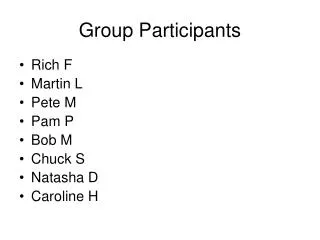
Group Participants • Rich F • Martin L • Pete M • Pam P • Bob M • Chuck S • Natasha D • Caroline H
Data Questions • What data needed to characterize CLs across broad landscapes (extensive) • What data are needed to establish cause/effect relationships (intensive) • How can we leverage existing data • What addtl data are needed • How to fill gaps
Four levels of data collection & analyses Intensive Sites I Gradient Survey G. S. Modeling* Probability Survey P. S. Extensive Sites Extensive * Allows for the identification of prioritized parameters
Extensive Sites • NADP/NTN • IMPROVE • ECOMAP • MDN • Natl wetland inventory • NHD • TEUI • Human pop density maps • NEI • AIRS
Extensive Sites – cont’d • Remote Sensing • Hyperspectral imagry • Tree health – insect/disease • MODUS (AQUA & TERRA) • Airborne lidar – canopy structure • Soil depth to bedrock? • Soil mosture
Probability Surveys • EMAP and FS Sfc water surveys • FIA/FHM • CWA 305B, 303D – STORET • Terrestrial survey (R3)
Gradient Surveys • Allows scaling from intensive to extensive • Linking can b e done via R. S. • Needs linking to maps (e.g., weathering) • Sources are from projects • Examples • NAWQA Synoptics • CA Bay Delta Study • PACFISH
Intensive Sites • Look at 7 remaining candidate FS sites identified from 2004 • CENR intensive sites • LTER • Experimental Forests (FS) • NPS 3 intensive sites • RMNP (Loch Vale), GSMNP, SNP • LTBMU • WACAP – NPS toxics • NPS Vital signs program • W. Adirondacks/Poconos, Catskills
Data Needs • Natl forest soils inventory • Regional maps of weathering • Disturbance maps • Fire • Harvesting • Drought • Extreme events • Additional intensive sites
Key Points • Western intensive sites/data are less certain in the west due to diversity, elevation differences, site sparseness • Data need to be collected simultaneously for both aquatic and terrestrial • Not just class I areas • Initial focus is on forests (prototype sites) but soon find alpine and range sites