Supported by ONR, DOD HPCMP
470 likes | 610 Vues
This work explores the calculation of magnetic anisotropies and exchange Hamiltonians in molecular magnets through Density Functional Theory (DFT). The study involves the use of Gaussian functions centered on each atom in molecules or crystals, specifically utilizing the PBE GGA DFT framework. Key findings include the determination of exchange coupling parameters, spin excitations, and magnetization barriers in systems such as Mn12-acetate. The interplay of quantum mechanical effects on electronic structure and spin ordering is highlighted, along with qualitative agreement with experimental data.


Supported by ONR, DOD HPCMP
E N D
Presentation Transcript
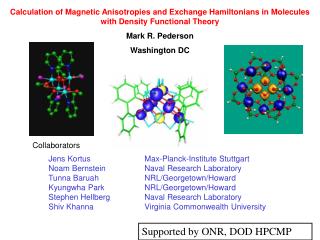
Calculation of Magnetic Anisotropies and Exchange Hamiltonians in Molecules with Density Functional Theory Mark R. Pederson Washington DC Collaborators Jens Kortus Max-Planck-Institute Stuttgart Noam Bernstein Naval Research Laboratory Tunna Baruah NRL/Georgetown/Howard Kyungwha Park NRL/Georgetown/Howard Stephen Hellberg Naval Research Laboratory Shiv Khanna Virginia Commonwealth University Supported by ONR, DOD HPCMP
NRLMOL + DFT FOR MOLECULAR MAGNETS Place Gaussians on each atom in molecule or crystal Yi(r) = Si Ci exp[-ai(r-Ri)2] |) DENSITY FUNCTIONAL FORMALISM USED (PBE GGA) Reduce Problem to Finding Expansion Coefficients
Exchange Coupling Parameters within Density Functional Theory? Small Anisotropy Example: V15 E1=-JS2 E2= JS2
Heisenberg Hamiltonian within DFT: [V15As6O42(H2O)] K6 [Kortus, Hellberg, Pederson PRL 86, 3400 (2001) ] J J’ J’’ Expt. DFT+ Heisenberg J2 J1 J1 J2 J’’ J J’ • Electronic Structure • Spin Ordering • Exchange Parameters Couple NRLMOL and many-spin Heisenberg Hamiltonian HF = lF Effective Moment vs Temperature Convergence? Diagonalize Many-Spin Hamiltonian for excitation spectra.
O C N H DFT Exchange Parameters: Mn12 is a classical Ferrimagnet (?!) Majority Spin Electrons Minority Spin Electrons = Mn Mn12O12(RCOO)16(H2O)4 1.5 nanometers • Interesting Deviations from classical bar magnet are due to: • “Large” Quantum Mechanical Effects (Defines Ideal Behavior) • “Small” Quantum Mechanical Effects (Complicates Behavior)
Mn3+ O2- Mn3+(S=2) Mn4+(S=3/2) Intramolecular exchange interactions:Mn12-acetate • S4 symmetry+3 inequivalent Mn sites : J1, J2, J3, J4 • Consider low-energy collinear spin-excitations • Use optimized ground-state geometry by DFT unknowns
Mn3+(S=2) Mn4+(S=3/2) DFT calculated exchange constants: Mn12-acetate • J1 , J2 : dominant, antiferromag. DFT: K. Park et al., PRB (2004) Ref.A: Regnault et al., PRB (2002). Qualitative Agreement with Experiment (50 %)
Spin excitation energetics • Heisenberg Hamiltonian DFT determined • Diagonalize H with DFT-determined Jij to find ground state & excited spin multiplets [ Lanczos method, Hellberg et al., JPSJ (1999). ] • Dimension of Hilbert space for Mn12-acetate: 108
S=9 33 K S=9 7 K S=9 41 K S=10 Calculated ground state & low-lying excited spin multiplets (Mn12-acetate) Park, Hellberg, Pederson, PRB (2004) Regnault et al., PRB (2002) Petukhov et al., PRB (2004) (2S+1)-fold degeneracy Experimental energy gap=35-40 K (Hill et al) “Classical” Ferrimagnet Configuration has amplitude of 0.6. Large but slightly smaller than that deduced from Godel et al
e- Energy Electric Field Electron Velocity e- Magnetic Field -S 0 +S Magnetic Anisotropy in Nanomagnets Electric Field Caused by Nuclei and Electronic Density Velocity Determined from Momentum Operator Computing Magnetic Effects due to Spin-Orbit Coupling Possible within Density-Functional Theory (Van Vleck 1937)
Energy/A <Sz> (M) Anisotropy HamiltonianPederson and Khanna PRB 1999 Effect on total energy due to spin-orbit L.S term Dependent on axis of spin quantization |1)= cos(/2) |) + eisin(/2) |) |2)=-eisin(/2) |) + cos(/2) |) To lowest order: (2nd order perturbation in L•S) Determine gab from DFT D2=Sabgab <Sa><Sb> DE2= -DSzSz - E(SxSx-SySy)
Q MAGNETOMOLECULAR ANISOTROPY ENERGYDE ~(1/4C4 ) M2 Spin Orbit Energy (Q) E= + DFT Energy ME’s (Q) = C4 (3.5x10⁸)
NRLMOL DIRAC EXPT Kr 3d 1.282 1.303 Kr 3p 7.551 7.883 Kr 2p 50.97 53.43 Mn 2p 10.3 11-12 Ru 2p 121 125 Accuracy of Non-Relativistic DFT for Spin-Orbit? GAS PHASE Mn[N-(CN)2]2 Molecular Magnetic Material M.R. Pederson, A.Y. Liu, T. Baruah, E.Z. Kurmaev, A. Moewes, S Chiuzbidian, M. Neuman, C.R. Kmety, K.L. Stevenson and D.Ederer, Phys. Rev. B 2002
Density of States for Passivated Mn12O12 Magnet Minority Gap: 2.03 eV Majority Gap: 0.43 eV • No Mn (4s) • S=10 • Ferrimagnetic Expt: Gaps at 1.08 and 1.75 eV [Oppenheimer et al, PRB 65 05449 (2002)]
Second Order Molecular Magnetic Anisotropy BarrierTheory vs. Experiment All Electron GGA (NRLMOL): 55.7 K Expt. (Barra et al,Fort et al) : 55.6 K
How does Magnetization Barrier Depend on Addition of A single Electron?
Mn Mn Mn O2- Mn Mn Mn Projected Onsite Anisotropies? T. Baruah et al, CPL 360144 (2002) Eg T2g Eg ~-1 Kelvin T2g ~10 Kelvin Majority Spin Insertion should decrease anisotropy Local JT distortion
S=13.0 S=11.5 S=10.5 EF S=10.0 Barrier (55K) RBM: 10.3K SCF: 7.2K Mn8Fe4-Acetate: Additional Majority Spin Electrons Should Reduce Barrier? Rough Prediction for Mn12O12+14: U~31K Good Agreement with Experiment…but situation is more complicated (See Park et al, PRB 2004)
Spin Manifolds inMn12-Acetate Park, Pederson and Hellberg PRB 69 014416 (2004) Sz Energy (eV) MAE (K) 10 0.000 54.21 9-b 0.062 54.56 9-c 0.145 54.98 8 0.138 55.09 6-c 0.038 55.03 6-b 0.080 55.35 5-a 0.134 55.52 5-b 0.092 54.92 13 0.151 53.70 N.B. None of these states are eigenstates of S^2 ! Above states are NOT connected by one and two electron operators
DFT Prediction: Spin Ordering, Magnetic Anisotropies and Resonant Tunneling of Magnetization in Nanomagnets. 2nd-Order Spin Orbit Energy Depends on Quantization Axis D2=-DCOS2Q + ESIN2QCOS(2b) Fe4 GGA-DFT EXPT Mn12 (D) 55 55 Mn12 (E) 0 0 Fe8 (E) 5.4 5.5 Fe8 (D) >50 29 Cr (D) 5.6 6.0 Mn10 (D) 9.5 8.0 Fe4 (D) 14.0 14.3 Fe4 (E) 1.6 1.4 Co4 (D) 27 ~100 Blind Test Mn12 Mn10 Fe8 Cr Co4
How does Magnetization Tunneling Rate Depend on Chemical Environment?
D H= -DSzSz + E(SxSx-SySy) + O(SxSx SxSx + SySy SySy) +…. Higher Order Effects Lead to Tunnel Splittings E: Dislocations, Solvent Disorder, Spin Vibron O: Spin Vibron, Higher Spin-Orbit, NCM Continuous Range of E’s would explain experimental observation
Symmetry Breaking Due to Solvents Leads to Transverse 2nd Order Terms (Cornia model) Six isomers of Mn12-acetate DFT calculations give maximum value of E~0.016 K Accord with Expt Park et al Phys. Rev. B 69 144426 (2004).
Does the Correct Electronic Structure guarantee understanding of Magnetic Anisotropy?
O C N H Fe8: A problem case Theory and Experiment disagree on Anisotropy Hamiltonian by a factor of two Fe8-TACN
Electronic Structure of Fe8 Theory + Experiment: Good Agreement (with Baruah, Musfeldt, Dalal and coworkers)
Conclusions • Good Agreement with Experiment • Some Verified Predictions within DFT …Still Lots of Questions Remain
4th-order = + Total 2nd-order 4th-Order Anisotropy (responsible for tunnel splittings) • Higher order terms in L•S: • exact electronic (non-self-consistent) total energy with L•S • coupling of spins to vibrations DE4=G SzSzSzSz + H [SxSxSxSx +SySySySy] = A1(4)[S2(Sz2-S2/3)] + A2(4)[3S4+35Sz4+30S2Sz2] + B1(4)[Sx4+Sy4-6Sx2Sy2] + … } cubic harmonics Can have different angular dependence and different scaling with 1/[speed of light]
Vibrational Contribution to Magnetic Anisotropies. Pederson, Bernstein and Kortus PRL 89 097202 2002 • Spin Orbit Interaction Depends on Electric Fields and Kohn-Sham Orbitals • Electric Fields and Kohn-Sham Orbitals depend on Atomic Positions/ Vibrational Displacements • Zero Point Energy of a Vibrational Mode Changes as a function of Spin Projection due to spin-orbit-vibron coupling. • Lowest-Order effect is 1/[Speed of Light]8
SPIN-ORBIT VIBRON INTERACTION [P2+w2Q2]/2 + gzz Sz2 +QSab (dgab/dQ)SaSb |Y=|f |SM E=w/2 + gzz M2 - (A+BM2)2/(2w2) S(S+1)[d/dQ(gxx+gyy)]/2 d/dQ[gzz -(gxx+gyy)/2] Compute total energy, forces, gab for all atomic displacements Extract: vibrations (IR, Raman) from dynamical matrix vibration-spin coupling from d/dQ(gab) Difficult calculations (shortcuts): must compare to experiment!
Calculated Total and Infrared DOS - Mn12-Acetate Large Mn-crown contributions in Region identified as field-dependent in IR experiments. (Sushkov et al)
TOTAL AND PROJECTED RAMAN INTENSITIES Good agreement between predicted Raman and recent experimental measurements (North et al) Raman Intensity Vibrational Energy (1/cm)
EVOLUTION OF 4TH-ORDER ENHANCEMENT WITH COUPLING TO VIBRONS Total and Mn projected weight NRLMOL+GGA: 6K - 1K = 5K EXPERIMENT: 5 – 10K
Results from Spin-Orbit Vibron Calculation Barra et al, PRB 56 8192 (1997) • 4th-Order Angular Terms: S4sin4q [G cos(4f)+H sin(4f)] • Demonstrated Mechanism for Isotope Induced Tunnel Splittings Co4: 4th-order barrier is 3% of 2nd-order barrier
U = E S2COS(2f) + GS4(COS4f+d) Spin Vibron X 10 SPIN-VIBRON MAX AT: 50, 140 SOLVENT DISORDER MAX AT:-15,165 Classical Energy (eV) Solvent Disorder Angle in XY Plane (degrees) Incommensurate Principal Axes From Solvent Disorder and Spin Vibron Maxima out of phase by ~20 or ~70 degrees (+/-10) Qualitative Accord with Experiment [del Barco et al, PRL 047203 (2003)]
Total Spin Local Spins Interference? Anisotropy Mn12: S=10 S=3/2 and S=2 Constructive Large Mn10: S=12/13 S=5/2 Destructive Small Mn12 vs Mn10?
Energy/A <Sz> (M) NANOSCALE MOLECULAR MAGNETS LONGITUDINAL FIELD Classical Barrier Hopping vs. Resonant Tunneling of Magnetization } Barrier changes continuously with Bz field Yellow States Aligned with Blue States only if: Bz = [DN]D/2 Discontinuous changes of demagnetization rate at integer fields due to RTM Observable in Hysterisis curves DW = MB - DM2/2 AKA: Zero-Field Splittings in atomic physics/radical chemistry
Co4 Based Molecular Magnet Baruah and Pederson, CPL 2002 Magnetic moment:12 mB Local Co moment:3 mB Addition of 4 hydrogens reduced moment by4 mB Anisotropy varies strongly with molecular distortions (20-60K) Uniaxial alignment Global easy axis along Z Lowest-energy staggered structure Good Agreement with more recent experiments.
Co-d Minority Minority Spin Co(3d) has 2 electrons } Co -d Majority Majority Spin Co(3d) Full DOS (Arb. Units) Minority Majority Energy (eV) Spin Projected Total and Cobalt Density of States
N Soft O Co Cl Hard Hard Medium Hard Easy Barrier = 23K Local Magnetic Anisotropy axes Global Anisotropy axes Orthogonal alignment of local hard axes results in a uniaxial system.
3 Equivalent Expressons for Spin-Orbit Coupling Classical and Quantum Mechanical Most Common Most Straightforward (Kittel, Schiff?)
Angle of Applied Transverse Field Log( Tunnel Splitting) (M=5) Applied Magnetic Field Lower Symmetry Molecules (Fe8): Berry’s Phase Oscillations A. Garg: EPL 22, 205 (1993) Period in transverse tunneling Experiments (kB/gmB)2[2E(E+D)]1/2 H=-DSzSz - E(SxSx-SySy) +HxSx