

SlideServe
Menu
Préférences
© SlideServe · v2026

Counting On / Back

seth avatar
10 diapositives · 445 Views · Jul 26, 2014

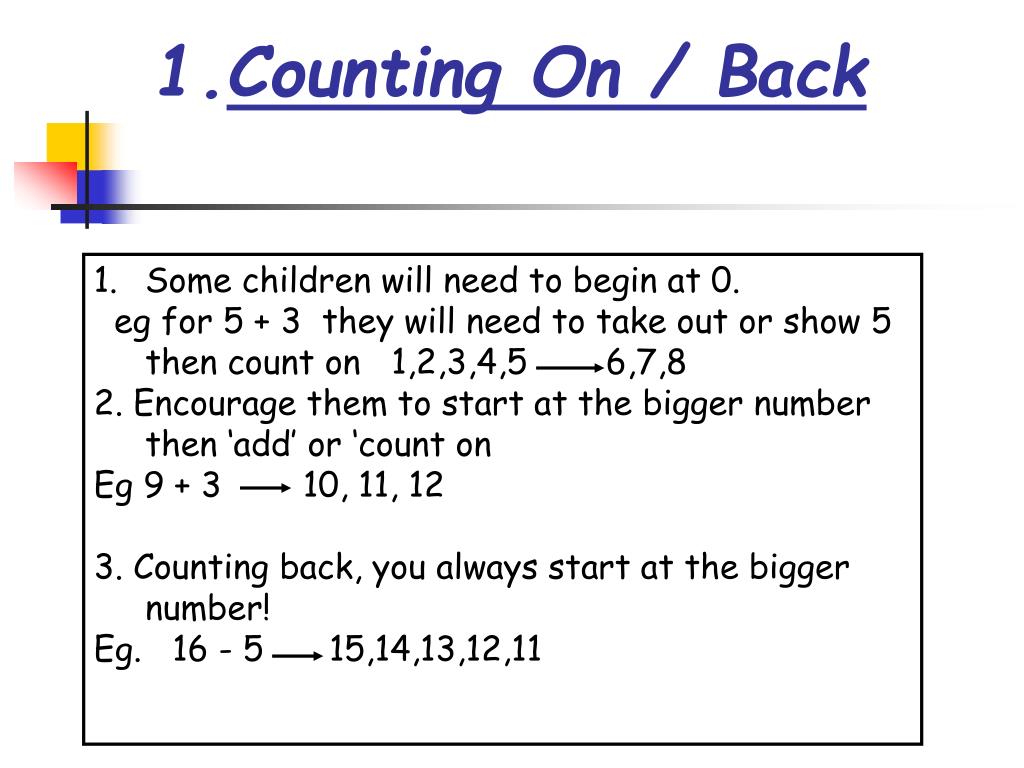
Counting On / Back . Some children will need to begin at 0. eg for 5 + 3 they will need to take out or show 5 then count on 1,2,3,4,5 6,7,8 2. Encourage them to start at the bigger number then ‘add’ or ‘count on Eg 9 + 3 10, 11, 12
Counting On / Back - slide 1
01 / 10Counting On / Back
1 / 17

Télécharger la présentation

Counting On / Back
Une image / un lien ci-dessous est fourni (tel quel) pour télécharger la présentation

Politique de téléchargement : le contenu du site vous est fourni TEL QUEL pour votre information et votre usage personnel ; il ne peut être vendu, concédé sous licence ni partagé sur d’autres sites sans l’accord de son auteur.Le contenu vous est fourni TEL QUEL, pour votre information et votre usage personnel uniquement. Téléchargez la présentation en cliquant sur ce lien. Lors du téléchargement, si vous ne parvenez pas à télécharger une présentation, l’éditeur a peut-être supprimé le fichier de son serveur.Pendant le téléchargement, si vous ne parvenez pas à obtenir une présentation, le fichier a peut-être été supprimé par l’éditeur.

F I N

Plus de contenu associé

Transcription de la présentation
  1. Counting On / Back Some children will need to begin at 0. eg for 5 + 3 they will need to take out or show 5 then count on 1,2,3,4,5 6,7,8 2. Encourage them to start at the bigger number then ‘add’ or ‘count on Eg 9 + 3 10, 11, 12 3. Counting back, you always start at the bigger number! Eg. 16 - 5 15,14,13,12,11

  2. 2. Jump Strategy Number lines are useful, especially with larger numbers. These can be numbered or ‘empty’ 6 + 5 = Eg __|____|____|____|____|____|____|____ 5 6 7 8 9 10 11 OR 34 + 25 __|________|________|___|___|___|___|___| 34 44 54 55 56 57 58 59

  3. 3.Doubling or near doubling 1. 6 + 7 is the same as 6 + 6 + 1 6 + 6 or ‘double’ 6 is a known or ‘practised’ number fact 2. 8 + 7 is the same as 8 + 8 - 1 = 16 - 1 = 15 3. 30 + 28 is the same as 30 + 30 - 2 = 60-2 = 58

  4. 4. Bridging to 10: 1. For an addition like 9 + 4 Add 1 to 9 first, then 3 more So 9 + 1 + 3 = 13 2. For larger addition facts: 27 + 28 27 + 3 + 25 = 30 + 25 = 55

  5. OR split then bridge 27 + 28 = 20 + 20 + (7 + 8) = 40 + 7 + 3 + 5 = 40 + 15 = 55 OR split, bridge and jump: go to http://www.curriculumsupport.education.nsw.gov.au/primary/mathematics/assets/images/)

  6. 5. Trading: Addition Initially done with concrete materials such as iceblock stick bundles or base 10 material so children can ‘see’ how they need to trade You can see this demonstrated at: http://www.allenandunwin.com/teachingmaths/secure/opsense_MABadd.htm#with

  7. a) Decomposition: h t u 5 6 4 5 6 + 2 7 5 7 3 1 • t u • 5 • 43 + • 38 • 81 The expression ‘borrow and pay back’ should not be used. ‘Add ten ones’ and ‘add ten’ is preferable.

  8. b) ‘Equal Addends’: h t u 69+ 83 1 5 2 The expression ‘carry the one’ should not be used. ‘Add ten ones’ and ‘add ten’ is preferable

  9. 6. Subtraction: a) Decomposition t u 3 42- 27 1 5 h t u 3 456- 385 71 You can see this demonstrated by going to: http://www.allenandunwin.com/teachingmaths/secure/opsense_MABsubtract.htm

  10. b) Equal Addends h t u 8 1 2- 6 9 3 1 1 9 1. Firstly add ten ones to units column. This becomes 12-3 which is 9 (units). 2. I must then take off this ten from the tens column. It can be taken from the bottom number as it will give the same answer as if it were taken from the top ie. 10-9 = 11-10. This is what the term ‘equal addends’ means 3. You then repeat the process for the hundreds column. The expression ‘borrow and pay back’ should not be used. ‘Add ten ones’ and ‘add ten’ is preferable