Enhancing Safety Culture in Health Services: A Commitment to Radiation Protection
The Radiation Protection Section is now part of the Department of Health and Human Services, maintaining the same contact details but with new email addresses. This highlights our focus on Safety Culture, asking, "How Safe is Safe?" By learning from airline and nuclear safety incidents, we recognize the core values and behaviors that shape an organization's commitment to safety. Key traits involve mutual trust, continuous learning, and encouraging open communication. Our goal is reasonable assurance of adequate safety for the protection of people and the environment.

Enhancing Safety Culture in Health Services: A Commitment to Radiation Protection
E N D
Presentation Transcript
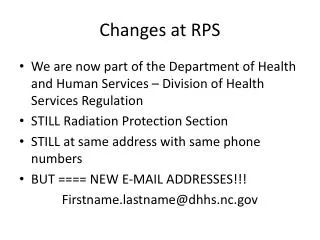
Changes at RPS • We are now part of the Department of Health and Human Services – Division of Health Services Regulation • STILL Radiation Protection Section • STILL at same address with same phone numbers • BUT ==== NEW E-MAIL ADDRESSES!!! Firstname.lastname@dhhs.nc.gov
Revolves around the question: How Safe is Safe? Risks Perception Consequences
Airline Safety 1,000,000 flight miles 5 year period from 2004 to 2009 67.5 accidents 3 fatal accidents
Nuclear Safety 14,400 Cumulative Reactor Years in 32 Countries 3 major accidents 2 of the 3 caused possible radiation fatalities in other countries Only 1 major US accident and it caused no fatalities
Safety Culture is: Organization’s core values and behaviors Everyone’s collective commitment to safety Emphasize safety over competing goals to ensure the protection of people and the environment
Safety Culture Traits Personal • Leaders demonstrate a commitment to safety • Everyone takes responsibility for safety • Mutual trust and respect between everyone
Safety Culture Traits Institutional • Encourages continuous learning about safety • Safety consciousness is “blame free” • Communications focus on safety
Safety Culture Traits Actionable • Questioning the work status quo is expected • Problems impacting safety are dealt with • Process planning and control promote safety
Safety Culture provides Reasonable Assurance of Adequate Safety, Not Absolute Assurance of Perfect Safety
“Safety Culture is where it’s at!” Existing Components Licensing/Registrations/Inspections Increased Security Controls LTS/WBL NMED/NSTS
Support of the Policy It is a given – being implemented Development requires Root Cause analysis backfit (preemptive déjà vu) Involve everything and everyone