Enhancing HIT Accessibility: Insights from the U.S. Access Board Meeting (Sept 14, 2010)
The U.S. Access Board discusses accessibility standards for Health Information Technology (HIT) in its September 14, 2010 meeting. Accessibility aims to eliminate barriers for individuals with disabilities, ensuring non-discrimination in technology. Section 508 of the Rehabilitation Act mandates that federal agencies provide accessible electronic and information technology. The Access Board promotes guidelines for accessible design and explores best practices to enhance HIT services. Key recommendations include elevating accessibility criteria, referencing Section 508 standards, and funding research for improved HIT accessibility.


Enhancing HIT Accessibility: Insights from the U.S. Access Board Meeting (Sept 14, 2010)
E N D
Presentation Transcript
HITAccessibility HHS HIT Policy Committee Meeting September 14, 2010 David Baquis, U.S. Access Board
U.S. Access Board • Independent Federal agency • Promulgates guidelines and standards for accessible design • Provides technical assistance and training • The term “Access Board” is used to refer to the staff of the Board, as well as the Board
Accessible Design • Accessibility does not mean “availability” • Design criteria which remove barriers that make it difficult or impossible for some people with disabilities to use HIT • Rooted in civil rights with intention to provide an assurance of non-discrimination in technology
Section 508 Accessibility Standards • Section 508 is part of the Rehabilitation Act • It applies only to Federal departments and agencies • It ensures accessibility of electronic and information technology • Section 508 authorized the Access Board to write technical design standards (published in 2000). Undergoing update now. • Intent: Ensure that the needs of people with disabilities are not overlooked as we move forward in the information age • Other countries and states are referencing 508 standards
Who Benefits? Disabilities: • Hearing • Vision • Speech • Mobility • Dexterity • Cognitive User groups: • Patient/clients • Clinicians • Caregivers/families • Students/instructors • Admin personnel
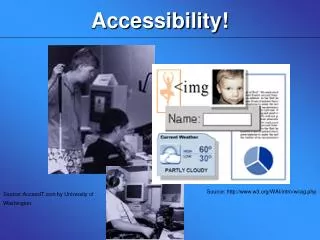
Web Based Resources • Are text equivalents provided for non-text elements? • Are multimedia videos captioned? • Are row and column headers identified in data tables?
Benefits of Accessible Design • Meaningful use certification • Improve “bottom line” via expanded customer base • Congruency with existing non-discrimination policies • Risk management • Strategic planning for potential DOJ ADA regulations
Recommendations in Brief • Elevate accessibility criteria to high level status • Reference the Section 508 Standards in the next iteration of HHS HIT Standards • Include accessibility in certification testing • Fund HIT accessibility research • Develop a technical assistance and training plan • Understand the impact of other rulemakings on HIT • Reduce burden by utilizing available resources