SlideServe
Menu
Préférences
© SlideServe · v2026

Understanding Organisms: Stimuli, Responses, and Observation Techniques

shadi avatar
46 diapositives · 587 Views · Jul 24, 2014

Explore key concepts of biology, focusing on organisms, stimuli, and responses. This guide discusses how living things react to various stimuli and the importance of observing these interactions. It includes examples to differentiate observations from claims, enhancing critical thinking skills. Emphasize the role of observations in scientific inquiry, and learn through engaging vocabulary quizzes and interactive activities designed to solidify your understanding of these fundamental concepts. Prepare for your upcoming tests and quizzes with confidence!
Understanding Organisms: Stimuli, Responses, and Observation Techniques - slide 1
01 / 46Understanding Organisms: Stimuli, Responses, and Observation Techniques
1 / 17

Télécharger la présentation

Understanding Organisms: Stimuli, Responses, and Observation Techniques
Une image / un lien ci-dessous est fourni (tel quel) pour télécharger la présentation

Politique de téléchargement : le contenu du site vous est fourni TEL QUEL pour votre information et votre usage personnel ; il ne peut être vendu, concédé sous licence ni partagé sur d’autres sites sans l’accord de son auteur.Le contenu vous est fourni TEL QUEL, pour votre information et votre usage personnel uniquement. Téléchargez la présentation en cliquant sur ce lien. Lors du téléchargement, si vous ne parvenez pas à télécharger une présentation, l’éditeur a peut-être supprimé le fichier de son serveur.Pendant le téléchargement, si vous ne parvenez pas à obtenir une présentation, le fichier a peut-être été supprimé par l’éditeur.

F I N

Plus de contenu associé

Transcription de la présentation
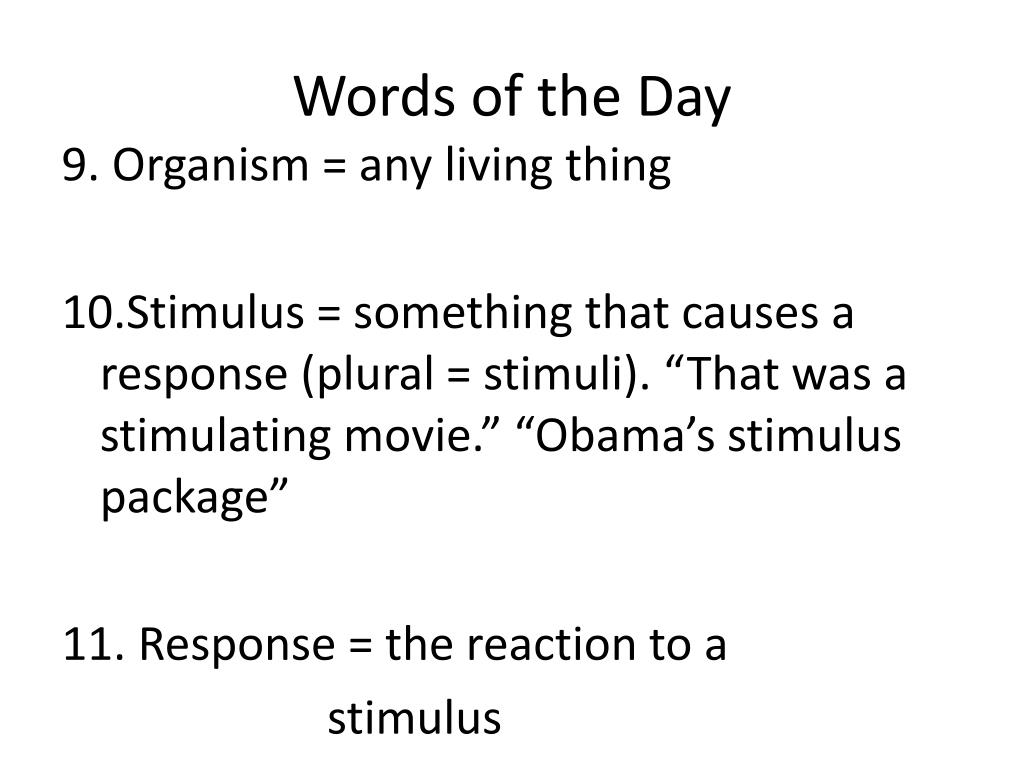
  1. Words of the Day 9. Organism = any living thing 10.Stimulus = something that causes a response (plural = stimuli). “That was a stimulating movie.” “Obama’s stimulus package” 11. Response = the reaction to a stimulus

  2. Put a O for observation, and a C for Claim • 1._______ Mr. Hobday’s hair was cut. • 2._______ He went to the barber. • 3. _______ His hair looks great!

  3. Write at least one Observation and one Claim for the photo

  4. Write at least one Observation and one Claim for the photo.

  5. Yak

  6. Yak Yorbi (Lopez Ortega)

  7. Jackal

  8. Jackal Josiah (Williams-Jones)

  9. Yellowhammer?

  10. Yellowhammer YaHoua (Xiong)

  11. Barracuda

  12. Barracuda Bee (Vang)

  13. Nuthatch

  14. Nuthatch Nhia (Thao)

  15. Newt

  16. Newt Natalie (Lopez)

  17. Panda(s)

  18. Panda Pao (Xiong)

  19. Kangaroo

  20. Kangaroo Kyle (Benshoof)

  21. Killer Whale (orca for extra…)

  22. Killer Whale Kai (Thao)

  23. Cow

  24. Cow Kao (Vang)

  25. Nightengale

  26. Nightengale Nick (Widerski)

  27. Sheep

  28. Sheep Selena (Cha)

  29. Horse

  30. Horse Jose (Lira Hernandez)

  31. Nightcrawler

  32. NightcrawlerHnubci (Vang)

  33. Kangaroo

  34. Kangaroo Keenan (Hopkins)

  35. Alligator

  36. Alligator Ayan (Saleh)

  37. Dinosaur

  38. Dinosaur Deante (Book)

  39. Quiz • Happy? If not, get a pass from your 5/10 teacher to come to study buddies to retake… today! (tomorrow = dance?) • Most said they want an A or B… 15 minutes EACH NIGHT? (or afternoon) • Learn from mistakes… • Got a ride on the bigger animals back • The animal’s fought.

  40. Pretest and first quiz on page 7? • Put this new Quiz on page 11 (glue) • We can see what you need work or requizzing on…. • Fish books open to pages 34-35

  41. Pg 6 – 1. Make an observation2. Make a claim3. Research

  42. Research • Read the article, underline challenging words or interesting facts. • Write at least one question in the margin. • Write definitions of 3 words you looked up or things you found interesting.

  43. PUT IN PLANNER!!! • Friday = Quiz (all vocab, able to make an observation and an inference) • Thursday Sept. 29 = Test (Like Pretest)

  44. 6 9.5 10.5 7.5 15 • 9 7.5 12 10 13 • 5.5 8 4.5 10 6.5 • 10 14 10 8 14.5 • 10 8 6.5 14 9 • 9 9 6.5 13 13 • 8.5 12 11 9 • 15. Average = Add up the numbers and divide by the number of numbers