Understanding the Autonomic Nervous System: Divisions, Roles, and Pathways
220 likes | 341 Vues
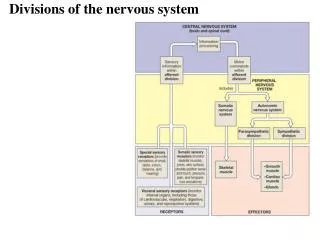
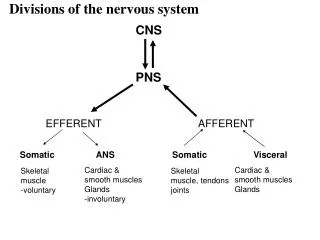
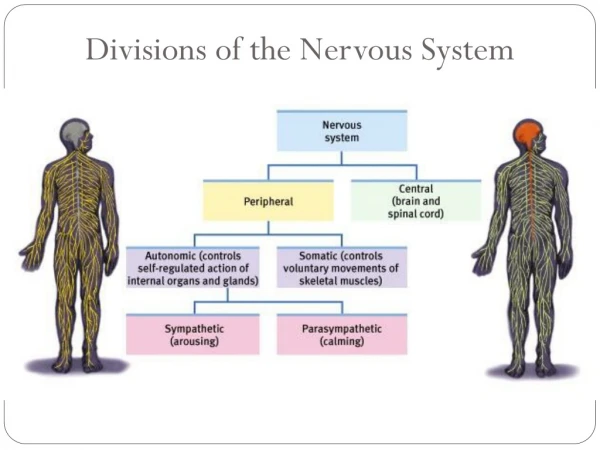
The Autonomic Nervous System (ANS) comprises two primary divisions: the sympathetic and parasympathetic. The parasympathetic division conserves energy during restful states by lowering heart rate and increasing gastrointestinal activity. Conversely, the sympathetic division mobilizes the body's resources in response to stress, enhancing heart rate and energy use. This article explores the anatomy and pathways of each division, detailing their functional roles, neurotransmitter activities, and reflexes. Gain insight into how these systems maintain homeostasis and respond to varying bodily demands.


Understanding the Autonomic Nervous System: Divisions, Roles, and Pathways
E N D
Presentation Transcript
Divisions of the ANS • ANS divisions: • mobilizes the body during _ • performs ___________________________________________ and conserves body energy • The two divisions provide _
Role of the Parasympathetic Division • Concerned with keeping body energy use low • Involves the _ • Its activity is illustrated in a person who relaxes after a meal • Blood pressure, heart rate, and respiratory rates are low • Gastrointestinal tract activity is high • The skin is warm and the pupils are constricted
Role of the Sympathetic Division • The sympathetic division is the _ • Involves _ • exercise, excitement, emergency, and embarrassment
Role of the Sympathetic Division • Promotes adjustments during exercise • blood flow to organs is reduced, _ • Its activity is illustrated by a person who is threatened • Heart rate ______________________________ and breathing is _ • The skin is cold and sweaty, and the pupils dilate
Sympathetic Outflow • Arises from spinal cord segments T1 through L2 • Sympathetic neurons form _ • Preganglionicfibers pass through the ______________________________________ and synapse in the chain (paravertebral) ganglia
Sympathetic Outflow • Fibers from T5-L2 • form _ • synapse with _ • Postganglionic fibers innervate the numerous organs of the body
Sympathetic Trunks and Pathways • The __________________________________ form part of the sympathetic trunk or chain • Typically there are 23 ganglia • 3 cervical • 11 thoracic • 4 lumbar • 4 sacral • 1 coccygeal
Sympathetic Trunks and Pathways • A preganglionic fiber follows one of three pathways upon entering the paravertebral ganglia • Synapse with the _ • _______________________________________ the sympathetic chain to synapse in another chain ganglion • Pass through the chain ganglion and _
Pathways with Synapses in Chain Ganglia • Postganglionic axons enter the ventral rami via the _ • These fibers innervate _ • Ramicommunicantes are associated _______________ with the sympathetic division
Pathways to the Head • Preganglionic fibers emerge from T1-T4 and synapse in the superior cervical ganglion • These fibers: • Serve the _ • Stimulate dilator muscles of the _ • Inhibit nasal and salivary glands
Pathways to the Thorax • Preganglionic fibers emerge from T1-T6 and synapse in the _ • Postganglionic fibers emerge from the middle and inferior cervical ganglia and enter nerves C4-C8 • These fibers innervate the ___________________ via the cardiac plexus, as well as innervating the _
Pathways to the Thorax • Other T1-T6preganglionic fibers synapse in the nearest chain ganglia • Postganglionic fibers directly serve the
Pathways with Synapses in Collateral Ganglia • These fibers (T5-L2) leave the sympathetic chain _ • They form thoracic, lumbar, and sacral _ • Their ganglia include • the • the superior and inferior mesenterics • the
Pathways to the Abdomen • Sympathetic nerves innervating the abdomen have preganglionic fibers from T5-L2 • They travel through the thoracic splanchnic nerves and synapse at the celiac and superior mesenteric ganglia • Postganglionic fibers serve the
Pathways to the Pelvis • Preganglionic fibers originate from T10-L2 • Most travel via the _____________________________________ splanchnicnerves to the inferior mesenteric and hypogastric ganglia • Postganglionic fibers serve the distal half of the large intestine, the ____________________________________, and the reproductive organs
Pathways with Synapses in the Adrenal Medulla • Fibers of the thoracic splanchnic nerve pass _ • Upon stimulation, medullary cells secrete ____________________________________________________________________________into the blood
Visceral Reflexes • ____________________________reflexes have the same elements as _______________________________reflexes • They are always _ • Afferent fibers are found in spinal and autonomic nerves
Referred Pain • Pain stimuli arising from the_______________________________ are _ • This may be due to the fact that visceral pain afferents travel along the same pathways as somatic pain fibers
Neurotransmitters and Receptors • Acetylcholine (ACh) and norepinephrine (NE) are the two major neurotransmitters of the _ • ACh-releasing fibers • ACh is released by all __________________________________________ axons and all parasympathetic _ • Adrenergic fibers • ______________________________________________ postganglionic axons that release NE • effects (excitatory/inhibitory) _