Overview of Early African Civilizations and Their Trade Dynamics
This overview explores the rich history of early African civilizations, particularly in Western Africa, as European exploration began. It details powerful kingdoms such as Ghana, Mali, and Songhai, which thrived through trade in valuable resources like gold, salt, and ivory, facilitated by their strategic geography near the Niger and Senegal Rivers. We also delve into the socio-political structures of these kingdoms, their religious beliefs, and the complexities of slavery, contrasting it with the American experience, highlighting that it was not race-based but often involved adoption into families.

Overview of Early African Civilizations and Their Trade Dynamics
E N D
Presentation Transcript
Early African Civilizations U.S History Mr. Szyzdek
Overview • Western Africa was home to many successful kingdoms around the same time as Europeans began to explore the world. • Powerful kings established their dominance in the lush coastal region near the Niger and Senegal Rivers. • The land provided many resources for trade including salt, pepper, gold, and ivory.
Geography Encourages Trade • The Sahara Desert covers most of the Northern part of the African continent. • Salt was the major resource found in the Sahara • The coastal valleys were ideal for the harvesting of gold. • Trading towns soon became powerful trading capitols.
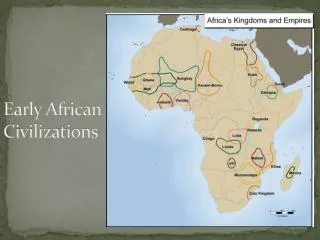
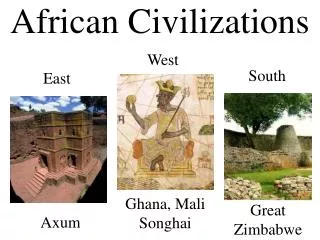
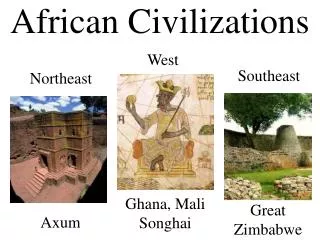
African Kingdoms • Ghana was one of the earliest of the great kingdoms of West Africa. • It expanded from the Sahara to the Gulf of Guinea and from the Atlantic to the Niger river. • It had a complex system of commerce, political structure, and stunning architecture. g
African Kingdoms Cont. • Attackers weakened Ghana's hold on trade routes. • By 1200, a new kingdom had taken over the region. • Mali- ruled by Mansa Musa who was Muslim. • Founded city of Timbuktu which was known for its university. • Kingdom weakened after death of Mansa Musa
African Kingdoms Cont. • Songhai (1400 A.D) – had been able to conquer Mali in 1468. • As a result, Songhai became the largest and most powerful kingdom in West Africa • Sustained the Islamic system of education.
Religious Beliefs • Many Africans held traditional beliefs: spirits lived in rain, trees, rocks, and animal life. • Spirits of ancestors were also honored • Muslim caravans bring not only goods but also religion.
Economics • Ancestral roots decided property ownership in many African societies. • The king also had power to take away and redistribute land among his officials. • Owning slaves or wives was a sign of wealth not property.
Slavery in Africa • Slavery was a common practice. • Slaves were usually people who were conquered, committed crimes, or found undesirable.
African vs. American Slavery • Slaves were usually adopted to families. • They could marry. Their children were born free. • Could often become soldiers or important officials. • Slavery NOT based on race!