Folding Experiments2
This overview focuses on key aspects of protein folding, highlighting methods such as UV absorbance and circular dichroism (CD) to study aromatic amino acids. The use of a stopped-flow device allows for the resolution of early folding events by monitoring UV/Vis, fluorescence, and CD signals. Additionally, insights into the role of folding accessory proteins like Protein Disulfide Isomerase (PDI) and GroEL are discussed, focusing on their functions in forming disulfide bonds and facilitating correct protein folding through ATP hydrolysis.

Folding Experiments2
E N D
Presentation Transcript
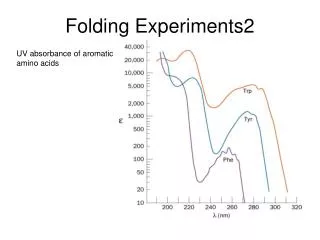
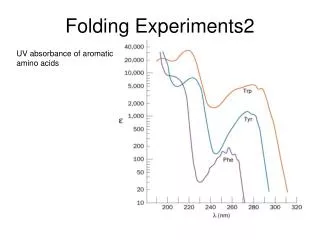
Folding Experiments2 UV absorbance of aromatic amino acids
Folding Experiments3 Circular Dichroism De is the difference in absorbance between left- and right-circularly polarized light…
Protein domain A folded protein is easily recognized
Folding Experiments1 Stopped-flow device: ms resolution of early folding events Monitor UV/Vis, fluorescence, or CD signals
Folding Accessory Proteins7 GRASP image of PDI (electrostatic surface potential: red=O- and blue=N+)
Folding Accessory Proteins6 • OXIDIZED Protein Disulfide Isomerase (PDI) • Forms protein’s initial S-S bonds in similar way (protein –SH attacks PDI S-S bond to give mixed disulfide) • Protein SH attacks protein-PDI mixed S-S bond to give protein S-S bond • Continues until protein in native S-S configuration and PDI cannot bind to exposed hydrophobic patches on the protein
Folding Accessory Proteins13 ATP hydrolysis doubles volume of cis cavity, all 7 ATP hydrolysis at one time, mechanically linked subunits expand simultaneously, can accommodate 70kDa polypeptide chain Big cavity Small cavity
Folding Accessory Proteins14 • One ring binds ATP7, substrate • GroES associates to cap it off • GroES binding causes hydrophobic • patches of cis ring to move to • interior GroEL position, depriving • substrate its binding sites • 2. It takes 13s for GroEL to • hydrolyse all 7 ATP and this • weakens affinity btw EL and ES • 3. Trans ring binds ATP7 and substrate • (must wait for cis ring to hydrolyse all 7) • 4. ATP, substrate binding induces • release of ES, ADP7, and substrate1 • (presumably better folded)