Spelling Unit #16: Understanding Consonant Doubling Rules and Common Confusions
In this unit, we explore the spelling rule for one-syllable words ending in a single consonant, which aren’t preceded by a single vowel. Learn not to double the consonant before adding -ing, -ed, -er, or -est. Familiarize yourself with key examples like "scalding," "weeping," "grouped," and "wielded." We'll also cover academic verbs, commonly misspelled words, roots, prefixes, suffixes, and commonly confused words including "whether" and "weather." This unit enhances your spelling skills and vocabulary comprehension.

Spelling Unit #16: Understanding Consonant Doubling Rules and Common Confusions
E N D
Presentation Transcript
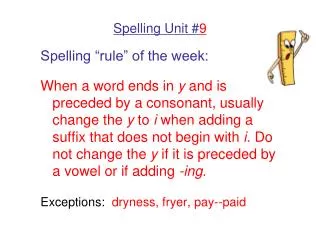
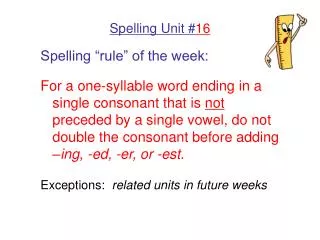
Spelling Unit #16 Spelling “rule” of the week: For a one-syllable word ending in a single consonant that is not preceded by a single vowel, do not double the consonant before adding –ing, -ed, -er, or -est. Exceptions: related units in future weeks
Focus Rule Words: 1) scalding (scald +ing) 2) weeping (weep +ing) 3) grouped (group + ed) 4) wielded (wield + ed) wield = to utilize, such as wield a sword 5) pleading (plead + ing)
Academic Verbs: 6) benefitto make better Education will benefit you. 7) featureto show or highlight The play features students from class. 8) generate to make or create You will generate several essays this year.
Commonly misspelled words: 9) governor (-or, NOT -er) 10) vacuum (one c, two u’s) 11) vegetable(Eat your veg-e at the table.)
Roots/prefixes/suffixes: ex = out hypo = under poly = many pseudo = false
12) except to cast out, not exclude 13) monopolyone controlling many 14) hypothesis an educated argument (thesis) based uponunderlying truths 15) pseudonym a false name (nym)
Commonly confused words: 16) whether (subordinating conjunction) often used with decisions Let’s decide whether or not to go. 17) weather (noun) The weather is nice outside.
Review Words: 18) cloths/clothes (rags, wearable items) 19) omniscient(omni + sci + ent) 20) judgment (judg [-e] + ment)