Comprehensive Conference Planning: A Guide to Effective Project Management
180 likes | 307 Vues
This guide outlines the essential steps to plan and execute a successful conference, utilizing a structured Work Breakdown Structure (WBS). Key focuses include defining project goals and objectives, estimating resources, and outlining dependencies among activities. The SMART criteria for task management ensure that each task is Specific, Measurable, Assignable, Realistic, and Time-related. Detailed examples include scheduling, budget estimation, and marketing strategies, all designed to culminate in a well-organized conference that meets participant expectations.


Comprehensive Conference Planning: A Guide to Effective Project Management
E N D
Presentation Transcript
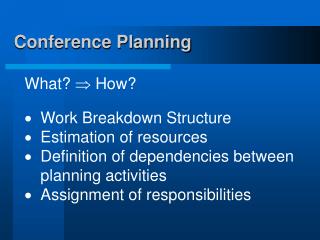
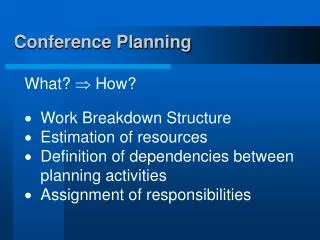
Conference Planning • What? How? • Work Breakdown Structure • Estimation of resources • Definition of dependencies betweenplanning activities • Assignmentof responsibilities
Work Breakdown Structure (WBS) • Project - Hierarchical system (tree): • Goal • Objectives • Workpackages • Tasks
Task S.M.A.R.T. Criterion: • Specific • Measurable (costs, work, time) • Assignable (responsibility) • Realistic • Time-related
TASK DESCRIPTION • Task ID, title, description • Input (outcomes of other tasks) • Title,type, description of a deliverable • Start and end time • Effort (e.g. in person-months) • Costs • Responsibility
Example: Conference planning • 1. Conference programme • 1.1 Define programmeof conference • 1.2 Obtain speakers • 1.3 Prepareconference materials • 1.3.1 Obtain presentations fromspeakers • 1.3.2Prepare and print conference materials
Example: Conference planning (2) • 2. Set theconference site & date • 2.1 Set the conference date • 2.2 Select & commit conference site • 2.3 Confirm arrangements
Example: Conference planning (3) • 3. Develop marketingplan • 3.1 Developandprintconference brochure • 3.2 Obtain Label Sets for Direct mailing • 3.3 Mail brochures • 3.4 Receive & acknowledgeregistrations
Duration of a Task • Task duration = Effort / No of persons • Random character Average time of activity duration: TA = (O + 4.M + P) / 6 • O - optimistic completion time • P - pesimistic • M – most likely completion time
COSTS CATEGORIES • Personnel costs • Equipment • Travel and subsistence • Consumables • Other directcosts • Subcontracting • Indirect Costs (overheads)
SEQUENCING THE PROJECT ACTIVITIES • Logical / time dependencies • Types of dependencies: • Finish Start („Immediate predecessor“) • Start Finish
Example: Conference planning Activity Title Imm. Pred. A (2.1) Date - B (1.1) Programme - C (2.2) Site A D (1.2) Speakers B E (3.1) Conf.broch. C, D C, D F (3.2) Database
Example: Conference planning(2) Activity Place Imm.Pred. G (3.3) Mailing E, F H (1.3.1) Obtain D I (3.4) Process G J (2.3) Finish H, I K (1.3.2) Print J
Example: Conference Planning A C E G I start F J K end B D H
ASSIGNMENTS • Planning – activity scheduling, assigment team members to tasks • Implementation – realocation of resources • Control – Comparision of plan and current status quo
Summary • Work break down structure (Tasks - S.M.A.R.T.) • Estimation of time and costs (duration, effort, costs) • Sequencing of activities • Project Proposal