Download
1 / 6
60 likes | 182 Vues
This text discusses the quantification of information value, both perfect and imperfect, emphasizing its role in decision-making. It highlights the principle that information should assist decision-makers in improving their choices compared to options made without it. The expected value of information is defined as the difference between the expected monetary value (EMV) with and without information. The accuracy of information plays a crucial role, demonstrated through examples and conditional probabilities. Ultimately, the text illustrates the significance of making informed decisions to maximize value.

E N D
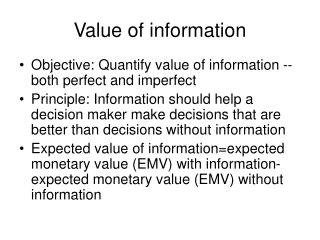
Value of information • Objective: Quantify value of information --both perfect and imperfect • Principle: Information should help a decision maker make decisions that are better than decisions without information • Expected value of information=expected monetary value (EMV) with information-expected monetary value (EMV) without information
Measuring accuracy of information • Value of information depends on decision we want to make and accuracy of information • Accuracy of information: P(expert says “A”/A occurs), P(expert says “A will not occur”/A does not occur). The higher these conditional probabilities, the more accurate is the information. • Perfect information: P(expert says “A”/A occurs)=1, P(expert says “no A”/A does not occur)=1.
Example I (0.1) 20 (0.2) 10 EMV=7 (0.6) 5 A (0.1) 0 B 6 If we have no information we will chose A; EMV with no information=7
Example: continued (0.1) A20 Choose A, payoff 20 (0.2) A 10 Choose A, payoff 10 A 5 (0.6) Choose B, payoff 6 A 0 (0.1) Choose B, payoff 6 EMV with perfect information=8.2 Value of perfect information=8.2-7=1.2
Example II (0.1) 20 (0.2) 10 (0.6) 8 A (0.1) 7 B 6 Option A dominates option B. Value of perfect information =0.