Download
1 / 5
50 likes | 194 Vues
This lecture explores the evolutionary development of ear ossicles and their role in balance and hearing. It examines the gradualism of evolution, the modification of existing structures, and the interdependence of anatomical features. Key highlights include the sensory cells in the semicircular canals and cochlea, and the intricate relationship between jaw joint evolution and ear structures. The lecture also emphasizes functional morphology and the transmission of forces in early synapsids, providing insights into the complexities of anatomical changes through evolutionary time.

E N D
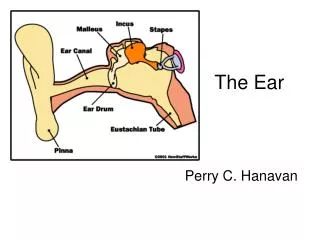
Semicircular Canals Sensory cells for balance 3 Ear Ossicles Malleus Incus Stapes Chochlea Sensory cells for hearing Tympanum Lecture 8 – Evolution of Ear Ossicles
Characteristics of Evolution Demonstrated by Ear Ossicles/Jaw Joint 1. Gradualism Evolution is often very gradual. We’ll see change from one morphology to a very different one in a finely graded set of steps. 2. Modification of existing structures For the most part, evolution modifies what’s already there, and when new structures arise (masseter) they split off existing structures. 3. Constraints & Exaptations Organisms are integrated wholes, and changes to a particular system don’t occur in a vacuum; characters are non-independent and functions change over time. Functional Morphology In equilibrium, any force that is being exerted is resisted by an equal and opposite force. 2. Resolve force vectors.
Early Synapsids Chain of transmission: Dentary Angular Articular {JJ} Quadrate Stapes Inner Ear
Malleus Meckle’s cartilage Development of Ear Ossicles in Didelphis