Download
1 / 51
Télécharger la présentation 
Understanding Celestial Bodies: The Relationship Between the Sun, Earth, Moon, and Tides
An Image/Link below is provided (as is) to download presentation
Download Policy: Content on the Website is provided to you AS IS for your information and personal use and may not be sold / licensed / shared on other websites without getting consent from its author.
Content is provided to you AS IS for your information and personal use only.
Download presentation by click this link.
While downloading, if for some reason you are not able to download a presentation, the publisher may have deleted the file from their server.
During download, if you can't get a presentation, the file might be deleted by the publisher.
E N D
Presentation Transcript
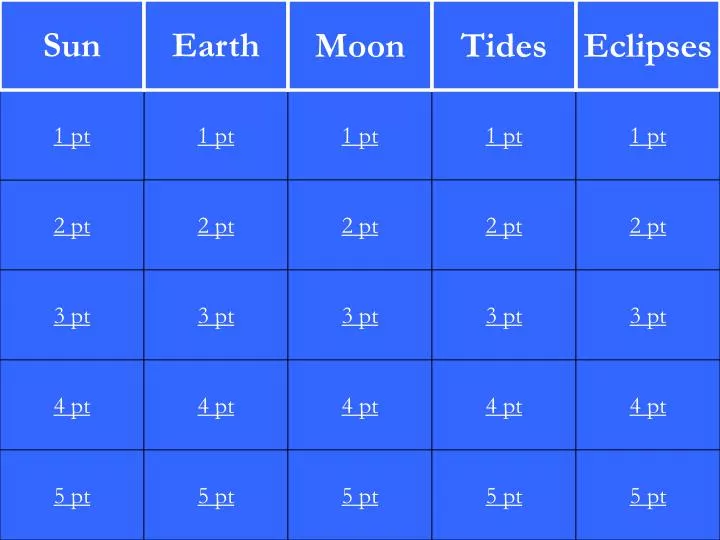
Sun Earth Moon Tides Eclipses 1 pt 1 pt 1 pt 1 pt 1 pt 2 pt 2 pt 2 pt 2 pt 2 pt 3 pt 3 pt 3 pt 3 pt 3 pt 4 pt 4 pt 4 pt 4 pt 4 pt 5 pt 5 pt 5 pt 5 pt 5 pt
The sun appears the same size as the moon in the sky for this reason
The sun as the center of the revolving planets is this model
The earth experiences day and night in 24 hours for these reasons
What are earth’s rotation and the sun only shining on half at a time?
When the northern hemisphere is this, the days are longer, there is direct light, and it is summer
Because the moon’s revolution and rotation take the same amount of time, this amount of time is equal to a day on the moon
This is why we don’t experience lunar and solar eclipses every month
More Related