
SlideServe
Menu
Préférences
© SlideServe · v2026

Exploring Noctilucent Clouds: Nature's Night-Shining Clouds in the Mesosphere

shaun avatar
15 diapositives · 291 Views · Aug 08, 2014

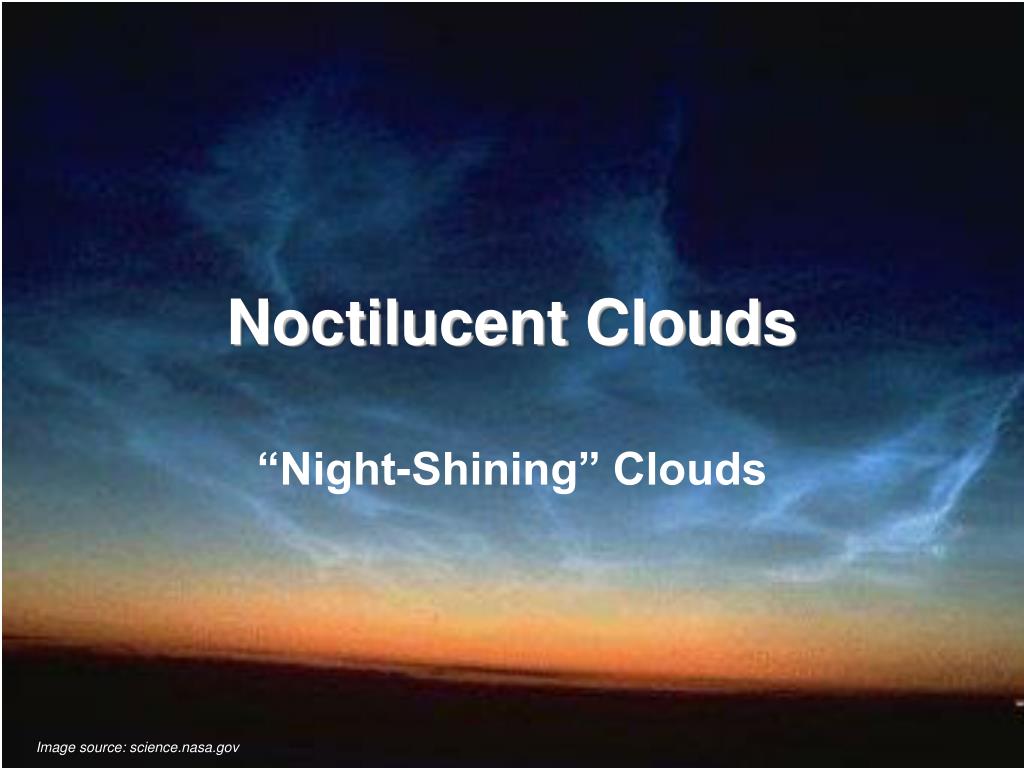
Noctilucent clouds, or night-shining clouds, are the highest clouds in Earth's atmosphere, found at around 80 km altitude in the mesosphere. Formed from water vapor frozen on dust particles, their presence raises intriguing questions about moisture sources, including summer upwellings, volcanic eruptions, and emissions from spacecraft. Visible only at twilight, they predominantly occur in polar regions and their brightness and frequency have increased since their first recorded observation in 1885. This phenomenon may be linked to global climate change or the rise in rocket launches, making the mesosphere a critical area for climate study.
Exploring Noctilucent Clouds: Nature's Night-Shining Clouds in the Mesosphere - slide 1
01 / 15Exploring Noctilucent Clouds: Nature's Night-Shining Clouds in the Mesosphere
1 / 17

Télécharger la présentation

Exploring Noctilucent Clouds: Nature's Night-Shining Clouds in the Mesosphere
Une image / un lien ci-dessous est fourni (tel quel) pour télécharger la présentation

Politique de téléchargement : le contenu du site vous est fourni TEL QUEL pour votre information et votre usage personnel ; il ne peut être vendu, concédé sous licence ni partagé sur d’autres sites sans l’accord de son auteur.Le contenu vous est fourni TEL QUEL, pour votre information et votre usage personnel uniquement. Téléchargez la présentation en cliquant sur ce lien. Lors du téléchargement, si vous ne parvenez pas à télécharger une présentation, l’éditeur a peut-être supprimé le fichier de son serveur.Pendant le téléchargement, si vous ne parvenez pas à obtenir une présentation, le fichier a peut-être été supprimé par l’éditeur.

F I N

Plus de contenu associé

Transcription de la présentation
  1. Noctilucent Clouds “Night-Shining” Clouds Image source: science.nasa.gov

  2. Image source: nasa.gov

  3. Image source: nasa.gov

  4. Noctilucent Clouds • Occur in Mesosphere ~80 km altitude • Highest clouds • Made of water frozen on dust particles (condensation nucleii) Image source: science.nasa.gov

  5. Where does the water come from? • Mesosphere is very dry; water must come from somewhere else • Summer upwelling of moist air • Space shuttle/ rockets • Volcanic eruptions Image source: science.nasa.gov

  6. Where do the particles come from? • Micro meteors • Comets • Volcanic eruptions Image source: science.nasa.gov

  7. Can only be seen at twilight Image source: science.nasa.gov

  8. Conditions for Formation • Only form where and when mesosphere is coldest • Polar regions • Can be seen between 50º -70º north and south of equator • Why not seen all the way to the poles? • Summer months • Seasonal air movements move coldest air to poles in summer Image source: science.nasa.gov

  9. source: nasa.gov NASA video clip (click box)

  10. The Mystery • No recorded observations before 1885 • Brightness, frequency and extent has been growing ever since Why? Image source: science.nasa.gov

  11. First Recorded in 1885 • Could the clouds have existed before this? YES! • Krakatoa erupted in 1883, creating dramatic sunsets that many enjoyed watching. The clouds could have existed unnoticed before this. Image source: science.nasa.gov

  12. Increasing Brightness, Frequency and Extent:Related to Global Climate Change? “greenhouse” gases increase= colder mesosphere = more noctilucent clouds Image source: science.nasa.gov

  13. Effect of Greenhouse GasesWhy does the Mesosphere get colder? If more of Earth’s emitted longwave radiation is held close to the surface, it is not available to cause warming in the upper atmosphere (not known for sure, more study needed) Image source: science.nasa.gov

  14. Increasing Brightness, Frequency and Extent:Not Related to Global Climate Change? Maybe related to increase in rocket launches in recent times. Each launch adds significant amount of water to mesosphere. Water needed for cloud formation. Image source: science.nasa.gov

  15. The Mesosphere is Important! We won’t fully understand how and why our climate is changing until we understand what’s happening up there The Mesosphere can no longer be the “Ignorosphere” Image source: science.nasa.gov