Download
1 / 3
40 likes | 183 Vues
This bulletin explores critical aspects of employer actions and employee rights during union representation elections. It highlights anti-union conduct, including the interrogation of employees, establishment of "company unions," and surveillance of union meetings. Key points include the employer's right to free speech under Section 8(c) and the implications of the "captive audience" doctrine. It also discusses the importance of "laboratory conditions" for fair elections and the potential consequences of violating these conditions. Understanding these dynamics is crucial for both employers and employees.

E N D
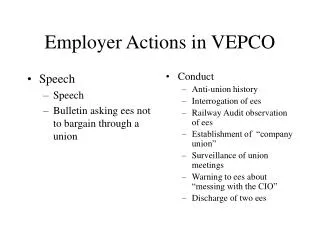
Speech Speech Bulletin asking ees not to bargain through a union Conduct Anti-union history Interrogation of ees Railway Audit observation of ees Establishment of “company union” Surveillance of union meetings Warning to ees about “messing with the CIO” Discharge of two ees Employer Actions in VEPCO
VIRGINIA ELECTRIC AND POWER (AND NOTE)Key Points • Employer right of free speech • since encoded in Section 8( c ) • Board may not base a finding of UFLP solely on speech • Totality of Conduct • Captive Audience Doctrine • Right of er to deliver captive audience speeches (Livingston Shirt, 1953) • Exceptions • within 24 hours of election (Peerless Plywood, 1953) • in presence of privileged no solicitation rule
“Laboratory Conditions” • Ideal conditions for a representation election • May be conceived of as conditions that would exist if employees in possession of full information and have had time for discussion and contemplation and are not improperly influenced by employer, union, or other employees • Violation of laboratory conditions by either side results in setting aside election • A party to election may compromise the laboratory conditions without committing a UFLP