Download
1 / 11
110 likes | 225 Vues
This article delves into the complex processes of digestion, focusing on the stomach's role in food processing, where smooth muscles mix food for 3-5 hours and produce chyme. It outlines the secretion of acids, enzymes, and hormones essential for nutrient absorption. The contributions of accessory organs, such as the pancreas and liver, are explored, detailing their functions in producing digestive enzymes and bile. Health-related conditions like peptic ulcers, hepatitis, and gallstones are discussed, illustrating the importance of a healthy digestive system.

E N D
The stomach and beyond Digestion part 2
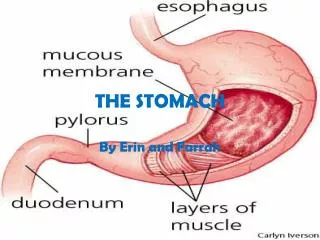
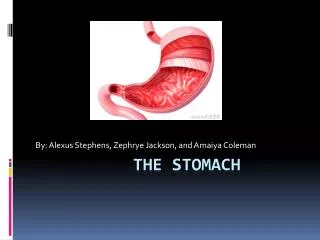
The stomach • Smooth muscles mix food (3-5 hours) • Acid secretion denatures food • Digestive enzymes begin to digest protein • (fat, carbohydrate to lesser extent) • Chyme is formed (food is liquefied); highly acidic
Very little absorption takes place • Water, electrolytes, aspirin, alcohol • Produces “intrinsic factor’ necessary for vitaminB12 absorption
Secretory structures of the stomach • Cells in mucosa secrete: • Acid (parietal cells) • Mucus (goblet cells) • Pepsinogen (chief cells) • hormones (G and D cells)
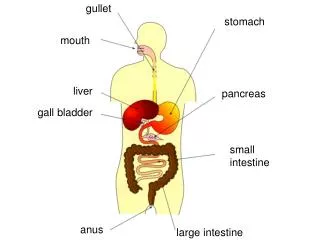
Accessory organs: pancreas • Secretes digestive enzymes into the small intestine • Pancreatic juice: amylase, trypsin, lipase, etc. • Secreted by acini (99% of pancreatic cells) • Remaining 1% form islets of Langerhans and secrete insulin and glucagon
Diverse functions of liver • Formation and secretion of bile • Metabolism of carbohydrates, lipids, proteins • Formation of plasma proteins • Detoxification of blood • Storage of vitamins and minerals • Clearance of aged cells
Small intestine receives and produces secretions • From pancreas and liver/gall bladder • Digestive enzymes • Brush-border enzymes • Crypts of Lieberkühn • Mucus • Goblet cells • Hormones • Immune function • Paneth cells
Large intestine • Compaction of solid waste • Bacterial breakdown of proteins; vitamin formation • Absorption of water, ions, vitamins • Defecation
Applications to health • Peptic ulcer- craterlike lesion caused by exposure to gastric juices. • Vomiting- forcible expulsion of the contents of the upper GI tract (stomach and duodenum). • Peritonitis- acute inflammation of the peritoneum. • Hepatitis- inflammation of the liver caused by viruses, drugs, or chemicals. • Gallstones- crystallization of cholesterol due to insufficient bile salts. • Appendicitis- inflammation of the appendix caused by an obstruction of the lumen.