Download
1 / 18
180 likes | 313 Vues
This guide provides an overview of electric current and resistance, explaining how current flows from negative to positive, and how it is measured. Key concepts include the flow of charge, the calculation of charge over time using current, and the factors that affect resistance in conductors, such as length, cross-sectional area, and temperature. Ohm's Law is introduced, along with practical calculations to find the resistance of materials, particularly focusing on an example of calculating the resistance of an aluminum wire.

E N D
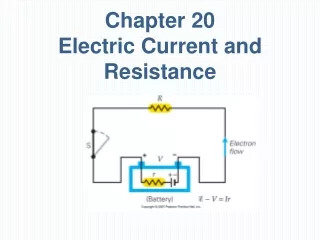
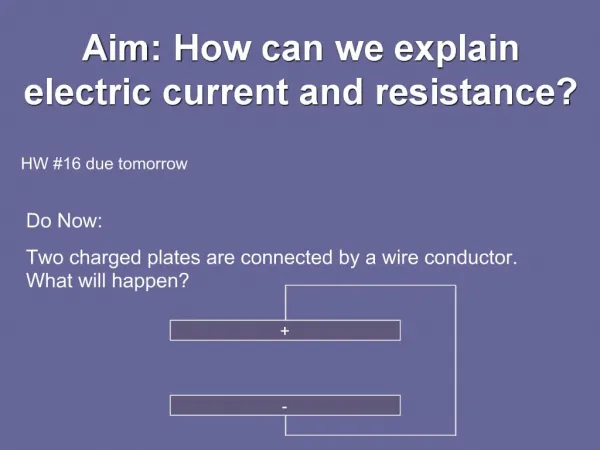
1. Aim: How can we explain electric current and resistance?
2. Electron Flow Current flows from negative to positive
3. Electric Current The “flow of charge” – the amount of charge that passes a single point in a period of time
5. A current of 2.0 A is flowing in a circuit. How much charge passes a given point in the circuit in 30 seconds?
I = ?q
t
2.0 A = ?q
30 s
(2.0 A)(30 s) = ?q
60 C = ?q
7. Resistance A measure of how easy or difficult it is for current to flow
8. Ohm’s Law
13. Graph of V vs. I
14. Resistance Increases when: Length of conductor increases/decreases
Cross sectional area of conductor increases/decreases
Temperature of metal conductor increases
Temperature of non-metal conductor decreases
15. Resistance of Conducting Wire R = Resistance (O)
? = Resistivity (O•m)
L = Length (m)
A = Cross Sectional Area (m2)
16. Resistivity
17. Calculate the resistance of a 2.0-m long Aluminum wire with a cross sectional area of 1.5 x 10⁻³ m2.
R = ?L
A
R = (2.82 x 10⁻⁸ O•m)(2.0 m)
(1.5 x 10⁻³ m2)
R = 3.8 x 10⁻⁵ O