Solutions
This comprehensive overview of the solution process details how solute dissolves in solvent, examining intermolecular attractions and energy changes involved. It explores the differences between physical and chemical changes during dissolution, emphasizing key concepts like "like dissolves like" and factors affecting solubility such as temperature and pressure. The piece also covers the steps of solvation, hydration of ionic solids, and the principles of Henry’s Law, providing insights into the behavior of gases and solids in solutions.


Solutions
E N D
Presentation Transcript
Solutions Part I: The Solution Process
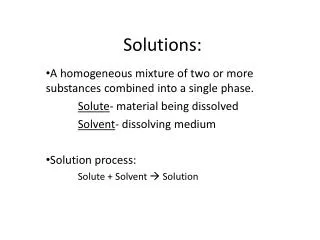
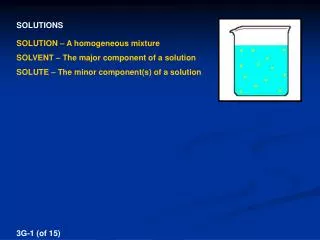
Solutions: • Solute: • Solvent
The solution process • To dissolve a solute in a solvent, the intermolecular attractions between solute and solute must be strong enough to compete with solvent-solvent and solute-solute attractions.
Dissolving an ionic solid in water • The ion-dipole attractions between the salt and the solvent must be strong enough to overcome the lattice energy
“Steps” of the solution process • Step 1
“Steps” of the solution process • Step 1 • Step 2
“Steps” of the solution process • Step 1 • Step 2 • Step 3
Why do processes occur? • Achieve a lower energy state • Exothermic processes lead to lower enthalpy
Why do processes occur? • More randomness • Greater “entropy” • Can more than compensate for increasing enthalpy
Did it dissolve, or did it react? • Just because a substance “disappears” into a solvent doesn’t mean that the substance dissolved!
Dissolving vs. reaction • Dissolving • Physical change • Can recover the original substance by evaporating the solvent
Dissolving vs. reaction • Dissolving • Physical change • Can recover the original substance by evaporating the solvent • Chemical change • New substances form
saturated unsaturated Solutions
“Like dissolves like” • Non-polar substances tend to dissolve in non-polar solvents
“Like dissolves like” • Non-polar substances tend to dissolve in non-polar solvents • Polar substances tend to dissolve in polar solvents.
“Like dissolves like” • It comes down to having similar intermolecular attractions.
Gases in solution • Solubility depends on intermolecular attractions
Gases in solution • Solubility depends on intermolecular attractions • London forces • As molar mass increases, dispersion forces are stronger
Henry’s Law • The solubility of a gas in a liquid is directly dependent on the gas pressure
Henry’s Law • The solubility of a gas in a liquid is directly dependent on the gas pressure • Pressure really doesn’t affect solubility of solids and liquids
Henry’s Law • Sg = kPg
Solubility and temperature • Usually, solubility of ionic solids increases with temperature
Gas solubility and temperature • Solubility of gases typically decreases with increasing temperature