Understanding Newton's 3rd Law of Motion: Action and Reaction Explained
190 likes | 330 Vues
Explore the intricacies of Newton's 3rd Law of Motion, which states that for every action, there is an equal and opposite reaction. Delve into the concept of forces as interactions between objects, illustrated with practical examples such as tug-of-war and everyday interactions. Gain insights into how forces act in pairs, understanding the importance of mass and the interactions between objects. Learn why action-reaction pairs are essential to our understanding of physics and the environment around us, enhancing your grasp of fundamental physical principles.


Understanding Newton's 3rd Law of Motion: Action and Reaction Explained
E N D
Presentation Transcript
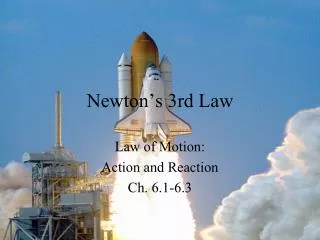
Newton’s 3rd Law Law of Motion: Action and Reaction Ch. 6.1-6.3
Objectives • Define force as part of an interaction • Newton’s 3rd Law of Motion • Identify action & reaction forces
I can’t touch you without you touching me • I can’t touch the desk without the desk touching me • I can’t exert a force on a body without the body exerting a force on me • Contact requires TWO objects!
Why do my fingers bend back more when pushing on hand & wall? • Because the wall pushes back! • Somebody push on my fingers… • Most people don’t see this. Physics types see the wall pushing back!
Forces and Interactions • Further defines idea we’ve been talking about this whole time • Force • an interaction between one thing and another • The Interaction Rule: • Object A exerts a force on object B • Object B exerts a force on object A
Forces and Interactions • Which block pulls harder? Check your neighbor. • The more massive block didn’t move very much? Is it pulling harder? • Add mass to the less massive block • Move about same • What can you say about force? Mass? • Remove mass. Which is pulling harder?
Tug-of-War • In a tug of war both teams pull with 1000 N. • There’s a scale in the middle of rope. What will the scale read? • 2000 N, 1000 N, or 0 N? Check your neighbor • Imagine if a person was in the middle. Definitely NOT 0 N pulling on each arm! • If one team gets tired, attaches rope to wall, puts up a curtain. Other team continues to pull. What will the scale read? • Pulling seems to be exactly the same, 1000 N
Tug-of-War • Student volunteer • Who’s pulling harder? • Forces are the same! • How do you win tug-of-war? • Push the hardest against floor • Girls vs. Boys demo • Fellas, take off your shoes
Rubber band Demo • Which is pulling harder? The thumb on the forefinger or the forefinger on the thumb?
Earth vs. Moon? • Is the distance from NY to SF the same distance as SF to NY? • Does the earth pull harder on the moon than the moon pulls on the earth (moon is only 1/6 mass of earth)? • No! There is a single gravitational interaction between the two • Action: A pulls on B; Reaction: B pulls on A
Newton’s 3rd Law • For every action, there is an equal and opposite reaction • There are two forces • Action force • Reaction force • Baseball clip • What are the action/reaction forces in these pics? • Forces always occur in pairs • The sound of ONE hand clapping is impossible
Kicking, punching, dropping and catching stuff • Kick/punch something (NOT another person!) • That object is pushing back on you with the same force that you kick/punch it with • Find two objects. Drop object A with one hand, catch it with the other. Do the same with object B. Which one required your hand to push back with the most force?
Action-Reaction in Action • Why do geese fly in a “V” formation? • Birds wings deflect air downwards--> air pushes bird upward • Creates updraft (greatest on side of bird) • Trailing bird positions itself in updraft to conserve energy • This bird creates updraft for following bird, and so on
Action-Reaction in Action Interesting Facts • Explain this picture using your knowledge about Newton’s 3rd Law • Travel up to 9 miles at night to feed and return • Equivalent of human waling 37 miles for dinner each night • Known to swim at 28 mph for miles and miles
Action-Reaction in Action • Explain the three pictures using your knowledge of Newton’s 3rd Law.
Let’s review the homework problemsand next-time question 6-1 p. 83 (#1-5)