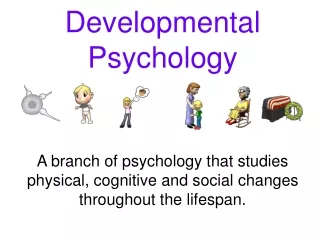
Developmental Psychology
220 likes | 351 Vues
This exploration of developmental psychology focuses on the influence of biological, cognitive, and sociocultural factors on human development. We evaluate attachment in childhood, highlighting how early relationships shape future connections. The discussion includes the potential effects of childhood trauma and deprivation, definitions of resilience, and strategies for building it. Key theories by Bowlby and Ainsworth, particularly the Strange Situation paradigm, are examined, alongside the implications of attachment styles on adult relationships based on self-report surveys.


Developmental Psychology
E N D
Presentation Transcript
Developmental Psychology Social Development 6.2
Learning Outcomes General framework (applicable to all topics in the option) • To what extent do biological, cognitive and sociocultural factors influence human development? • Evaluate psychological research (that is, theories and/or studies) relevant to developmental psychology.
Learning Outcomes Social development • Examine attachment in childhood and its role in the subsequent formation of relationships. • Discuss potential effects of deprivation or trauma in childhood on later development. • Define resilience. • Discuss strategies to build resilience.
Examine attachment in childhood and its role in the subsequent formation of relationships
Attachment • John Bowlby1907-1990 • Developed Attachment theory • Studied children from the WWII who had been separated from their parents. • Found that many had emotional problems and linked this to separation from their mother. • Believed that attachment was an innate pattern and helped infants to survive. • Basic biological need. • If deprivation – permanent and irreversible damage
InternalWorkingModel • Infants developworkingmodels of the worldbased on the development of a secure and attachment relationshipwith a parent or caregiver. • In such a situation, the childdevelopaworkingmodel of the world as safe and secure. • Oterhwise – negative workingmodels (the world is dangerous, frightening…) • It willchange and incorporate new ways.
InternalWorkingModel • If the child experiences love and affection, he or she come to see himself or herself as worthy of love and attention. • If they have experienced neglect and rejection they might develop a model of denial (or on the reality)
The Strange Situation • Mary Ainsworth 1913-1999 • developed Bowlby’s ideas and came up with how to test attachment theory empirically • - called the strange situation paradigm • She was a student to Bowlby • Conducted research in Uganda (1967) and then in Baltimore (U 1971) studied children and mother interactions: resulted in SSC
The Strange Situation • Studies the child’s reaction to separation and reunion with the attachment figure (often the mother) • The parent and child are alone in the room • The child explores the room without parental participation • A stranger enters the room, talks to the parent and approaches the child • The parent quickly leaves the room • The parent returns and comforts the child
Types of attachment • Type A – avoidant (20% of the children) • Type B – Securely attached (70% of the children) • Type C – ambivalent (10 % of the children) • Type D – insecure-disorganised/disorganised attachment (came later – 1986, by Main and Solomon)
The Strange Situation - Mary Ainsworth One example of “a strange situation”http://www.youtube.com/watch?v=s608077NtNI
What is your attachment style? • http://www.web-research-design.net/cgi-bin/crq/crq.pl • This interactive survey takes about 5 minutes to complete. The questionnaire is designed to measure your 'attachment style'--the way you relate to others in the context of intimate relationships
Evaluation of the attachment theory and the strange situation Evaluateusing: • Gender • Culture • Method • Ethics • Anythoughts? • Read p. 197-199 ifyouneedhelp
The role of early attachment in the subsequent formation of relationships • Internalworkingmodelscontinuethroughout the lifespan • Relationshipbetween the experience of attachment in childhood and adult love relationships
Hazan and Shaver’s Love Quiz • Read the followingstatements and indicatewhichparagraph best describesyourattitutetoclose relationships – on page 200 (A, B or C)
Hazan and Shaver’s Love Quiz’s research 1987 • Put in a newspaper and asked for volunteersto pick ”a box” and todescribetheirparents’ parentingstyles. • 620 peopleanswered (self-selected), 14-82 years old, mean age 36. 205 males and 415 females. • Second sample of 108 college students.
Hazan and Shaver’s Love Quiz’s research Results: • 20% showed A (anxious-avoidant: ”unresponsive, rejecting”) • 60% showed B (secureattachment: ”attentive and responsive”) • 20% showed C (anxious- ambivalent: ”anxious, sometimesresponsive”)