Download
1 / 1
10 likes | 170 Vues
In this post-lab report, we explore the principles behind thermocouples, focusing on converting voltage readings to temperature values using a voltage-temperature conversion table. Calculations include converting three temperature values from Celsius to Fahrenheit using the appropriate formulas. We also address wrap-up questions, detailing the microscopic working mechanism of thermocouples and analyzing potential sources of error that may have influenced our results. This comprehensive approach will enhance understanding of thermoelectric principles and thermocouple applications in temperature measurement.

E N D
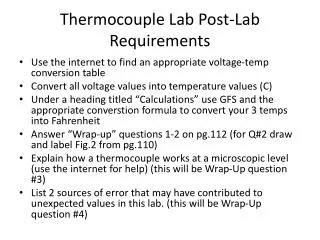
Thermocouple Lab Post-Lab Requirements • Use the internet to find an appropriate voltage-temp conversion table • Convert all voltage values into temperature values (C) • Under a heading titled “Calculations” use GFS and the appropriate converstion formula to convert your 3 temps into Fahrenheit • Answer “Wrap-up” questions 1-2 on pg.112 (for Q#2 draw and label Fig.2 from pg.110) • Explain how a thermocouple works at a microscopic level (use the internet for help) (this will be Wrap-Up question #3) • List 2 sources of error that may have contributed to unexpected values in this lab. (this will be Wrap-Up question #4)





![Requirements Analysis Visual Modeling] Lab 02](https://cdn5.slideserve.com/9296882/requirements-analysis-visual-modeling-lab-02-dt.jpg)