Understanding Boyle's, Gay-Lussac's, and Charles' Laws in Gas Behavior Analysis
110 likes | 244 Vues
This educational resource covers essential gas laws, including Boyle's Law, Gay-Lussac's Law, and Charles' Law, explaining their fundamental principles and relationships. Boyle's Law illustrates the inverse relationship between pressure and volume; Gay-Lussac's Law demonstrates the direct relationship between pressure and temperature; and Charles' Law explores the direct relationship between volume and temperature. Problems are provided to apply these laws, enhancing understanding through examples involving pressure, volume, and temperature calculations.


Understanding Boyle's, Gay-Lussac's, and Charles' Laws in Gas Behavior Analysis
E N D
Presentation Transcript
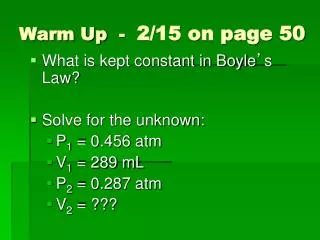
Warm Up - 2/15 on page 50 • What is kept constant in Boyle’s Law? • Solve for the unknown: • P1 = 0.456 atm • V1 = 289 mL • P2 = 0.287 atm • V2 = ???
Gay-Lussac’s Law • Created by Joseph Gay-Lussac • Deals with changes in pressure and temperature (volume kept constant) • As one increases, the other increases as well (direct relationship)
Formula • P1 = P2 • T1 T2
Example • At 120°C, the pressure of a sample of nitrogen is 1.07 atm. What will the pressure be at 205°C? • P1 = 1.07 atm • T1 = 120°C • P2 = ??? • T2 = 205°C
Example • (1.07 atm) = P2 • (120°C) (205°C) • (1.07 atm)*(205°C) = P2 • (120°C) • P2 = 1.80 atm
Charles’ Law • Created by Jacques Charles • Deals with changes in volume and temperature (pressure kept constant) • As one increases, the other increases as well (direct relationship)
Formula • V1 = V2 • T1 T2
Example • A gas at 65°C occupies 4.22 L. At what Celsius temperature will the volume be 3.87 L? • V1 = 4.22 L • T1 = 65°C • V2 = 3.87 L • T2 = ???
Example • (4.22 L) = (3.87 L) • (65°C) T2 • (4.22 L)*T2 = (3.87 L)*(65°C) • T2 = (3.87 L)*(65°C) = 59.6°C • (4.22 L)