Understanding Cellular Catabolism and the Laws of Thermodynamics
240 likes | 368 Vues
This packet explores essential concepts of cellular catabolism, focusing on the laws of thermodynamics that govern energy transformation, metabolism, and respiration in living organisms. It defines energy, metabolism, and the roles of ATP in sustaining cellular functions. The text details processes like aerobic and anaerobic respiration, electron transport, and the importance of vitamins, particularly B vitamins, as coenzymes in metabolic reactions. This comprehensive overview highlights how cells maintain order and energy flow through intricate biochemical pathways.


Understanding Cellular Catabolism and the Laws of Thermodynamics
E N D
Presentation Transcript
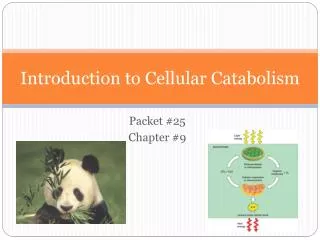
Introduction to Cellular Catabolism Packet #25 Chapter #9
Laws of Thermodynamics • Energy is defined as the capacity to do work and takes a number of forms • Light; heat; chemical • The 1st law of thermodynamics • Energy cannot be created or destroyed but changed from one form into another. • When scientists used the term that energy is lost, they are simply stating that it (energy) has been converted into a form which cannot be usefully available for a particular purpose. • The 2nd law of thermodynamics • All natural processes tend to proceed in a direction which increases the randomness or disorder of a system. • All natural processes tend to high entropy.
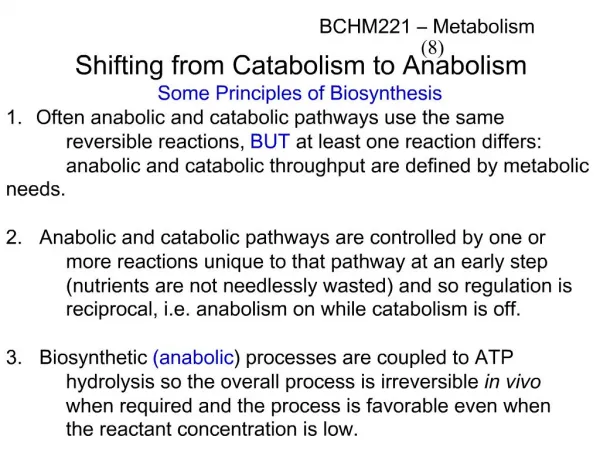
Energy & Chemical Reactions I • The summation of chemical reactions, via the use of enzymes, that occur within living organisms is called metabolism. • Metabolism is divided is divided into two groups • Anabolism • Catabolism
Energy & Chemical Reactions II • The reactions that make up these processes may either be termed exogonic or exergonic. • Exogonic • Chemical reactions that release energy • Exergonic • Chemical reactions that absorb free energy.
Entropy & Living Organisms • Living organisms maintain low entropy by taking their chemical energy in the form of food. • This food is converted into a form of energy called ATP.
Functions of ATP • In a metabolically active cell, up to 2 million molecules of ATP are required every second. The ATP is used for a variety of purposes. • Anabolic processes • Active Transport • Movement • Activating reactants • Chemicals often require the addition of phosphate groups from ATP to make them more reactive • Phsophorylation of glucose at the beginning of glycolysis. • Secretion • ATP provides energy for the secretion of cell products.
ATP & Energy Yields • Adenosine triphosphate (ATP) is the form in which energy is temporarily stored from the breakdown of glucose. • The removal of the final phosphate, when changing ATP to ADP, releases 30.6 kJ mol-1 of energy. • ATP + H2O -> ADP + phosphate + 30.6 kJ
Types of Respiration • Gaseous Exchange • External respiration (Organ System—Respiratory System) • Processes involved in obtaining oxygen needed for respiration and the removal of gaseous waste such as carbon dioxide. • Cellular Respiration • Internal/tissue • Biological processes which take place within living cells that release energy
Cellular Respiration • Cells require a constant supply of energy to generate and maintain the biological order that keeps them alive. • The energy is derived from the chemical bond energy in food molecules. • Sugars, such as glucose, are particularly important fuel molecules. • Animal cells obtain sugars, and other molecules such as starch that are converted to sugars by eating other organisms. • Heterotrophs
Types of Cellular Respiration • Aerobic Respiration • The oxidation of glucose to produce energy via the use of oxygen. • Sugar molecule is broken down and oxidized to CO2 and H2O. • Energy is derived from the chemical bond energy stored in the sugar. • Anaerobic Respiration • Production of energy without the use of oxygen.
Aerobic Cellular Respiration • Cellular respiration is a complex metabolic process of over 70 reactions that can be divided into three stages • Glycolysis • Kreb’s Cycle (Tricarboxylic acid cycle) • Electron transfer system • Chemiosomosis
Electron (Hydrogen) Carriers • Electron (Hydrogen) carriers are also known as acceptor molecules. • Electrons are collected by electron carriers molecules and passed to electron carriers at lower energy levels. • The electrons are at lower energy levels. • The energy released, as the electrons move to lower energy levels, is used to form ATP from ADP.
Electron (Hydrogen) Carriers II • The electrons are initially part of a hydrogen atom. • Hydrogen coming directly, or indirectly, from glucose. • Hydrogen atom eventually splits into a proton and an electron.
Electron (Hydrogen) CarriersExamples • Nicotinamide adenine dinucleotide • NAD • Nicotinamide adenine dinucleotide phosphate • NADP • Flavine adenine dinucleotide • FAD • Cytochromes
Respiratory Quotients • A respiratory quotient (RQ) is a measure of the ratio of carbon dioxide evolved to the oxygen consumed: • RQ = CO2evolved / O2consumed • For a hexose sugar, such as glucose, used during cellular respiration, it can be seen from the equation • C6H12O6 + 6O2 6CO2 + 6H2O • The ratio is 6CO2/6O2 = 1.0 • For a fat such as steric acid, RQ = 0.7 • Other RQ’s • Malate = 1.33 • Proteins = 0.9 (varies slightly based on particular protein)
Vitamin B • The group of vitamins, called vitamin B, plays a major role in cellular respiration—particularly by acting as coenzymes. • Found in green and leafy vegetables.